make preferable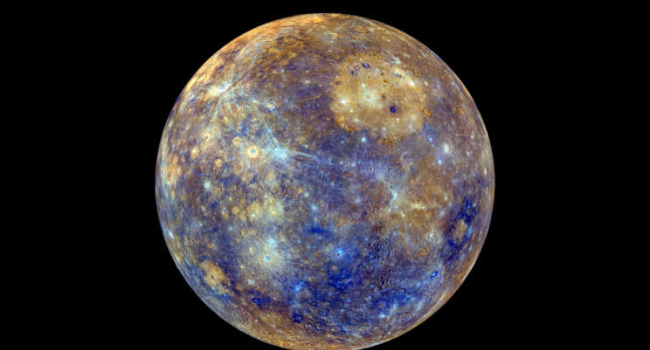
Mercury, the smallest and most enigmatic planet in the Solar System, has long puzzled astronomers. About 70% of its mass is concentrated in its enormous metallic core, while its mantle is disproportionately thin. A new study by an international team of scientists offers a fresh perspective: Mercury may have formed as a result of a “grazing” collision between two protoplanets of roughly equal size. This explanation appears more natural than the earlier giant-impact hypothesis. The results were published in Nature Astronomy.
The Puzzle of Mercury: Why Is Its Core So Huge?
Mercury—the planet closest to the Sun—has a radius of just 2,440 km, about half that of Mars. Its core makes up 70–85% of its volume, whereas on Earth it’s about 50%. Previously, scientists suggested that Mercury lost most of its mantle and crust after colliding with a large asteroid or protoplanet. However, such a catastrophic event would be too rare and doesn’t explain Mercury’s geochemical composition.
“Our calculations show that no extraordinary event is required to form Mercury. A side-on impact between bodies of similar mass would suffice,” explained lead author Patrick Lennon, a planetary scientist at the Paris Institute of Globe Physics. “Such a scenario is far more likely in the dynamics of the early Solar System.”
How Did the “Grazing” Impact Happen?
In the early Solar System (about 4.5 billion years ago), the inner regions were crowded with protoplanets—rocky bodies the size of the Moon or Mars, competing for stable orbits. Lennon’s team used the Smoothed Particle Hydrodynamics (SPH) method to simulate the collision of two such protoplanets, each with 0.5–1 Earth masses.
The simulations showed:
- A grazing impact at an angle of about 30–45 degrees stripped away up to 60% of one protoplanet’s mantle, leaving behind its core.
- The stripped mantle material either dissipated into space or was absorbed by another planet (possibly Venus).
- The resulting body preserved Mercury’s characteristics: a large, metal-rich core and a thin silicate mantle.
The models reproduced Mercury’s mass and metal/silicate ratio with 95% accuracy. This explains why the planet is so dense (5.43 g/cm³) and why it retains a magnetic field—a relic of its core.
Why Is This Better Than the Old Theory?
The previous hypothesis suggested a direct, catastrophic impact that would have vaporized the mantle, but it overlooked:
- The rarity of such an event.
- Geochemistry: Mercury is poor in volatile elements, as if they were blown away into space.
- Dynamics: in the early Solar System, oblique collisions were common and more probable.
The new scenario fits the bigger picture: protoplanets often collided at angles, exchanging material. The ejected matter could have ended up on Venus, explaining its thick mantle.
What’s Next?
Scientists hope to confirm the model using data from the BepiColombo mission (ESA/JAXA), which reached Mercury in 2025. Its spectrometers and magnetometers will gather data on the planet’s composition and magnetic field to test the simulations.
“Mercury is the least-studied planet, but this is changing. Many discoveries lie ahead,” Lennon concluded.
In Brief…
A new scenario suggests that Mercury was born from a grazing collision between two protoplanets, explaining its oversized core and thin mantle without invoking rare catastrophic events. Simulations show that such an impact could strip away 60% of the mantle, leaving behind the metallic heart. This fits the dynamics of the early Solar System and may also account for Venus’s composition. The 2025 BepiColombo mission is expected to provide key data to confirm the theory. Mercury may no longer be such a mystery—it is simply a survivor of a cosmic collision.