make preferable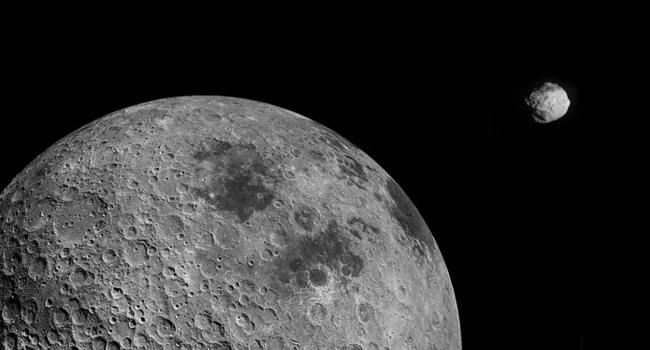
The asteroid 2024 YR4, discovered last year, initially sparked panic: calculations showed a 3% chance of impact with Earth. Later, the risk for our planet was ruled out, but scientists now warn of a 4% chance of collision with the Moon in December 2032. Debris from the impact could pose a threat to satellites and stations. This was reported in a study whose preprint is available on arXiv.
From Threat to Earth to Danger for the Moon
The asteroid 2024 YR4, about 60 meters in diameter, was first classified as potentially hazardous for Earth. But updated models from NASA and ESA reduced the risk to zero for our planet, shifting attention to the Moon. The probability of a lunar impact is 4%, but the consequences could be global.
“An impact would eject a huge amount of debris into space, increasing the flow of micrometeoroids toward Earth by thousands of times for several days. This threatens satellites and the ISS,” the authors note.
The asteroid’s mass is estimated at between 51 and 711 million kg, which complicates calculations. The collision would create a crater up to 1 km in diameter, ejecting fragments that would spread throughout near-Earth space.
Defense Options: Deflection or Destruction
Scientists propose two approaches:
- Deflection: altering the asteroid’s orbit. The earlier, the easier — even a small push is enough. But accurate planning requires knowing its mass, which will only be clarified in 2028. Reconnaissance in 2028 would be ideal, but launching a mission within three years may be unrealistic. An alternative could be to repurpose NASA’s OSIRIS-APEX or Psyche (launching in 2029).
- Destruction: a kinetic impact or nuclear explosion. A megaton-class charge would guarantee breaking the asteroid into fragments, regardless of mass. However, the nuclear option is controversial: physics confirms its effectiveness, but politics and treaties (such as the 1967 Outer Space Treaty) prohibit weapons in space. Moreover, the method has never been tested.
Decisions on a mission must be made soon — launch windows are closing.
Why Does It Matter?
A lunar impact would not directly damage Earth, but the resulting debris could create a “meteor storm”, threatening orbital infrastructure. By 2032, a lunar base under the Artemis program may exist, but currently it does not. The event would serve as a real-world test for planetary defense, much like the DART mission (2022), which altered the orbit of Dimorphos.
In Short…
The asteroid 2024 YR4 has a 4% chance of hitting the Moon in 2032, potentially producing debris dangerous for Earth’s satellites and stations. Deflection or destruction are possible solutions, but precise data will only be available in 2028. The situation is a reminder of the need to prepare for space threats — even those that are indirect.