make preferable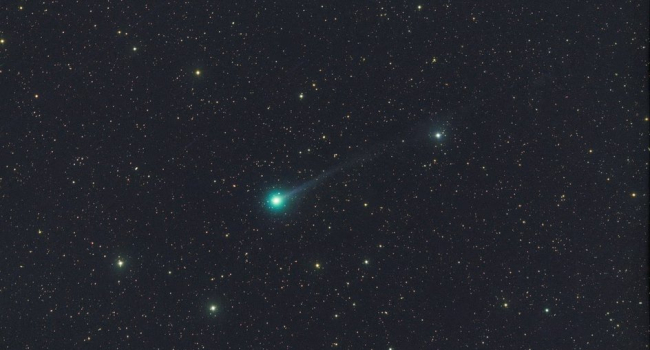
The comet C/2025 A6 Lemmon, discovered in early 2025, is rapidly approaching Earth and will make its closest pass on October 21, 2025, at a distance of less than 90 million kilometers. The Solar Astronomy Laboratory of the Space Research Institute (IKI) of the Russian Academy of Sciences reported this in its Telegram channel. Soon, the celestial object will become visible through binoculars and possibly to the naked eye, promising a bright spectacle for residents of the Northern Hemisphere.
The Comet’s Path
As of September 24, 2025, the comet is located 200 million kilometers from Earth. Over the next 10–14 days, it will reach a brightness of magnitude 5, making it visible through binoculars across Russia. The comet will reach its peak brightness in late October to early November, when it comes closest to Earth.
“The comet will be visible at high and mid-latitudes of the Northern Hemisphere,” noted Sergey Yazev, senior researcher at the Institute of Solar-Terrestrial Physics SB RAS and professor at Irkutsk State University, in an interview with TASS. For now, its brightness is too faint for the unaided eye, but this will change in the coming weeks.
What Is Comet Lemmon?
Comet C/2025 A6 Lemmon was discovered under the Mount Lemmon Survey program (USA) using a telescope in Arizona. It belongs to long-period comets, with orbits spanning hundreds or thousands of years. Its nucleus, made of ice, dust, and gases, heats up as it approaches the Sun, forming a bright tail visible from Earth.
The comet poses no threat to our planet: a distance of 90 million kilometers is about 0.6 astronomical units (the distance from Earth to the Sun), which is safe. However, its brightness and visibility make it an important target for astronomers and skywatchers alike.
How to Observe It
To see the comet:
- When: From mid-October, peaking in late October–early November.
- Where: Best viewed outside cities, away from light pollution.
- Tools: Binoculars or a small telescope; at peak brightness, it may be visible to the naked eye.
- Location: The comet will be visible in the constellation Cassiopeia (easy to spot by its W-shaped pattern).
Precise coordinates and viewing times can be checked in astronomy apps such as Stellarium.
Scientific Significance
Comets are “guests” from the distant Oort Cloud, preserving information about the early Solar System. Studying C/2025 A6 Lemmon will help scientists:
- Refine knowledge of comet nucleus composition.
- Understand heating and ice sublimation processes.
- Compare it with other comets, such as C/2023 A3 (Tsuchinshan-ATLAS).
“Comets are time capsules preserving the chemistry of the young Solar System,” emphasized IKI RAS researchers.
In Short…
Comet C/2025 A6 Lemmon promises to be one of the brightest astronomical events of autumn 2025. Starting October 21, it will pass within 90 million km of Earth, reaching peak brightness in early November. Visible through binoculars — and possibly to the naked eye — it will attract the attention of astronomers and enthusiasts across the Northern Hemisphere. Beyond the spectacle, it offers a chance to glimpse into the Solar System’s distant past.