make preferable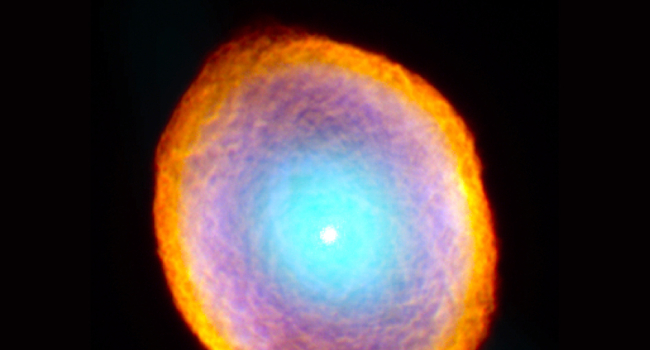
Astronomers from the University of Manchester and the University of Hong Kong have, for the first time, tracked how the planetary nebula IC418, known as the “Spirograph” in the constellation Lepus, has changed over the past 130 years. The study, published in The Astrophysical Journal Letters (AJL), revealed unusually rapid heating of the central star, forcing a rethinking of stellar evolution models and their role in the creation of carbon — a key element for life.
The Story of IC418: From Discovery to Hubble
The nebula IC418, discovered in 1891 by Williamina Fleming, formed when a red giant shed its outer layers in the final stage of life, becoming a white dwarf surrounded by glowing gas. The uniqueness of this study lies in the fact that scientists gathered data spanning 130 years — from the first 19th-century spectroscopes to observations with the Hubble Space Telescope. This allowed them to build a “timeline” of the object’s evolution.
Accelerated Aging of the Star
The main finding: the central star of IC418 has heated by 3,000 °C in just over a century — roughly 1,000 °C every 40 years. For comparison, the Sun took tens of millions of years to achieve similar heating in its early stages.
“The star is heating faster than the models predict,” noted Albert Zijlstra of the University of Manchester. “This calls into question our understanding of stellar evolution.”
This “accelerated aging” may be linked to:
- An unexpectedly low progenitor mass — only about 40% greater than the Sun’s, lower than anticipated.
- Internal processes not yet accounted for in models, such as uneven mass loss.
Carbon and Life in the Universe
IC418 is rich in carbon, expelled into space during the nebula’s formation. Planetary nebulae like this one are a major source of carbon in the Universe — without which organic life would be impossible. Scientists emphasize that stars with masses between 1–8 solar masses, which end their lives as white dwarfs, produce up to 90% of the carbon in galaxies.
“IC418 shows how relatively low-mass stars enrich the cosmos with carbon,” the authors explained. “This is key to understanding how the elements of life spread throughout the Universe.”
The Power of Archives
The research drew on unique historical data:
- 19th-century spectra taken with primitive instruments.
- Glass photographic plates preserving brightness and spectral details.
- Modern observations from Hubble and ground-based telescopes.
“The old plates are a treasure trove,” the researchers noted. “They let us see evolution happening in real time.”
Why Does This Matter?
The discovery reshapes views on stellar evolution:
- New models: the rapid heating of the star requires revised theories about the final stages of stellar life.
- Carbon cycle: understanding how nebulae like IC418 enrich space helps explain the origin of life’s elements.
- Historical data: 19th-century archives proved their value for modern science.
What’s Next?
Scientists plan to study other planetary nebulae to see if IC418 is unique. New telescopes, such as James Webb, will help detail their composition and dynamics. This will also improve models predicting the fate of the Sun, which will become a white dwarf surrounded by a similar nebula in 5–6 billion years.
In Short…
The planetary nebula IC418 has revealed a mystery: its star is heating faster than expected, raising new questions about stellar evolution. Over 130 years of observations, scientists have watched the “Spirograph” enrich space with carbon — the foundation of life. This discovery, based on data ranging from 19th-century plates to Hubble, shows how past and present science combine to unlock the future of the Universe.