make preferable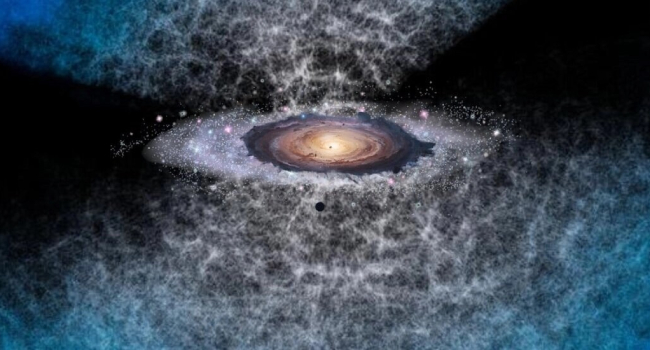
An international team of scientists has made a breakthrough in studying the structure of the Universe by developing the program Effort.jl, which allows calculations that previously required supercomputers to be performed in just minutes on a regular laptop. The new tool opens the way to creating the most detailed maps of the “cosmic web” — a giant network of galaxies, stars, and voids that form the framework of the cosmos. The results of the study were published in the Journal of Cosmology and Astroparticle Physics (JCAP).
What is the “Cosmic Web”?
The “cosmic web” is the structure of the Universe, consisting of filaments, walls, and voids that link galaxies into a single network. It formed over billions of years under the influence of gravity and dark matter. Studying this structure helps us understand how the Universe evolved, how galaxies arose, and which physical laws govern space.
However, constructing models of large-scale structure is a task that requires enormous computing power. Modern projects such as DESI (Dark Energy Spectroscopic Instrument) and the European mission Euclid collect colossal amounts of data that are difficult to process even on supercomputers.
Effort.jl: A Revolution in Computing
The Effort.jl program, created by scientists led by Marco Bonici from the University of Waterloo, solves this problem. It is based on the effective field theory of large-scale structure — an advanced model that statistically describes the “skeleton” of the Universe, linking observations to fundamental physics.
“Our emulator works like a neural network that has learned how the model predicts changes under different parameters. This allows us to instantly obtain results without recalculating everything from scratch,” Bonici explained.
Key Features of Effort.jl:
- Speed: Calculations that took hours on supercomputers are now completed in minutes on a laptop.
- Resource efficiency: The program requires fewer training data, since it accounts for patterns in parameter changes.
- Accuracy: In some cases, the emulator proved more accurate than the original model, as it allows additional aspects of analysis that are usually simplified for speed.
First Results and Prospects
Testing Effort.jl on simulated and real data showed that its accuracy is close to that of the full model. This makes it a reliable tool for processing the vast amounts of information from DESI and Euclid, which in the coming years will provide the most detailed maps of the “cosmic web.”
“We have created a tool that can handle future data flows and allow astrophysicists to analyze the structure of the Universe faster,” Bonici noted.
Why Is This Important?
Effort.jl opens new opportunities for science:
- Accelerating research: Rapid modeling of the Universe’s structure will help refine cosmological theories.
- Accessibility: Complex computations are now available not only to major observatories but also to universities with limited resources.
- Preparation for new data: The DESI and Euclid missions will soon provide terabytes of information, and Effort.jl will be key to their analysis.
The program may also help in studying dark matter and dark energy, which make up about 95% of the Universe but remain a mystery.
What’s Next?
Scientists plan to improve Effort.jl by adding support for new data types and models. In the coming years, with the launch of the Euclid mission (2023–2029) and the expansion of DESI, the tool will become the foundation for creating the most accurate maps of the “cosmic web” in history. This will bring humanity closer to understanding how the Universe formed and which forces govern its evolution.
In Brief…
Effort.jl is a revolutionary tool that allows the study of the “cosmic web” faster, more accurately, and more cheaply than ever before. A program that runs on a regular laptop opens the door to analyzing data from DESI and Euclid, promising the most detailed maps of the Universe’s structure. This is not just a technical breakthrough, but a step toward solving the mysteries of the cosmos — from dark matter to the birth of galaxies.