make preferable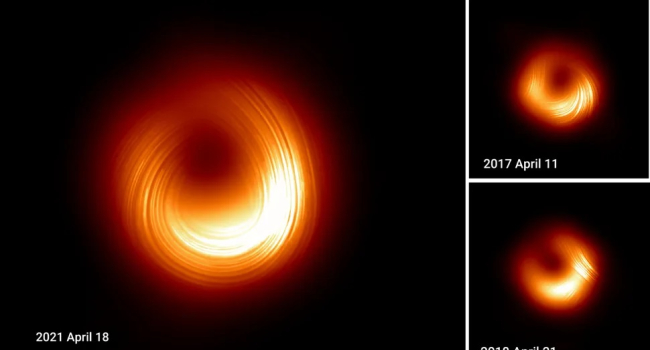
New stunning images of the supermassive black hole at the center of galaxy M87, captured by the Event Horizon Telescope (EHT), show that this object is far from static. First photographed in 2019, the black hole M87* (55 million light-years from Earth) is now revealing new secrets: its magnetic fields changed polarization over four years, and a jet of matter can be seen bursting from its surroundings. These findings, published in Astronomy & Astrophysics (August 2025), reshape scientists’ understanding of how matter behaves under extreme conditions.
A Shift in Magnetic Fields: What Scientists Saw
The new images of M87* revealed that the polarization of the magnetic fields around the black hole, which is 6.5 billion times the mass of the Sun, completely changed between 2017 and 2021. In 2017, plasma — superheated, magnetized gas — rotated in one direction around the black hole, slowed in 2018, and by 2021 had begun rotating in the opposite direction.
Researcher Chongho Pak from Kyung Hee University in South Korea said that the fact the polarization shifted between 2017 and 2021 was completely unexpected. He explained that this challenged existing models and showed that much remained unknown about the processes at the event horizon.
The size of the bright ring around the event horizon, known as the black hole’s “shadow,” stayed unchanged, confirming Einstein’s theory of relativity. However, the dynamics of the plasma proved to be extremely complex. Astronomer Paul Tiede from the Harvard-Smithsonian Center for Astrophysics stated that the plasma at the event horizon was not static but turbulent and complicated, forcing scientists to reconsider theoretical models.
The Jet of Matter: A Key to Black Hole Influence
For the first time, EHT managed to observe in detail the base of the relativistic jet — a stream of particles ejected from the surroundings of M87* at nearly the speed of light. Directed by magnetic fields toward the black hole’s poles, these jets play a crucial role in shaping galaxies by pumping enormous amounts of energy into the surrounding environment. The new images allowed scientists to study how the black hole “feeds” on nearby matter and how this affects its activity.
The cause of the polarization changes remains unclear. Scientists suggest it may be linked to a combination of the plasma’s magnetic structure and external factors, such as the accretion of new material.
How EHT Improved
The sharper images became possible thanks to improvements in EHT’s system. In 2021, two new instruments joined the telescope network: Kitt Peak in Arizona and NOEMA in France. This expanded the sensitivity of the system, which now includes 25 ground- and space-based instruments. In the future, image quality will improve even further with upgrades to telescopes in Greenland and the James Clerk Maxwell Telescope.
Astronomer Mariafelicia De Laurentis from the University of Naples Federico II stated that EHT was being transformed into a fully-fledged scientific observatory, one that not only delivered unique images but also provided a more complete understanding of black hole physics.
Why It Matters
The new data on M87* help scientists:
- Refine models of matter behavior under extreme conditions.
- Understand how black holes shape galaxies through relativistic jets.
- Test Einstein’s theory of relativity in real-world conditions.
The changes in plasma polarization indicate a turbulent environment around the black hole, potentially influencing its ability to consume matter. This discovery raises new questions about the nature of black holes and their role in the universe.
What Comes Next?
EHT will continue to observe M87* and other black holes, such as Sgr A* at the center of the Milky Way. Improvements in equipment and data-processing algorithms will allow deeper study of:
- The dynamics of magnetic fields and plasma.
- Processes of matter accretion.
- The relationship between black holes and galaxy evolution.
Michael Janssen, co-leader of the team from Radboud University in the Netherlands, emphasized that every year the EHT improves by adding telescopes, updating equipment, and developing new algorithms. He added that these results posed fresh questions that would keep scientists engaged for years to come.
In Brief
The new EHT images of M87* revealed that the magnetic fields around the first black hole ever photographed shifted their polarization within four years, while the plasma behaved in unexpectedly turbulent ways. For the first time, scientists examined the base of the relativistic jet, shedding light on the black hole’s role in galaxy formation. Supported by EHT’s improvements, these findings open a new chapter in black hole research and confirm that even six years after the first image, M87* continues to surprise scientists.