make preferable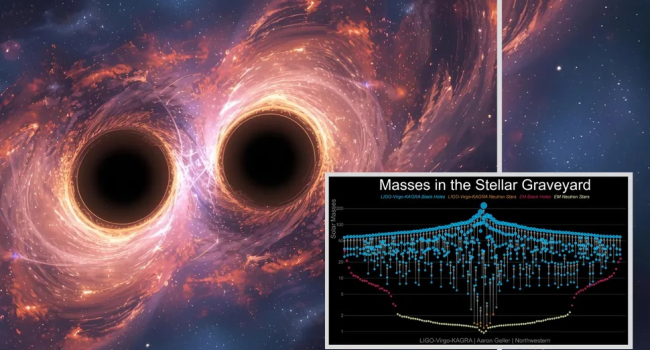
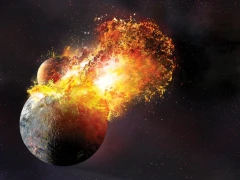
Astronomers have made a new discovery while studying gravitational waves — faint ripples in space-time first predicted by Albert Einstein in 1915. Using them, scientists found that the universe is filled with a “stellar graveyard” — a region where extreme remnants of stars, such as black holes and neutron stars formed after supernova explosions, merge. The news was reported by Space.com.
Doubling Discoveries: New Data from LIGO, Virgo, and KAGRA
The international network of gravitational-wave detectors — LIGO (USA), Virgo (Italy), and KAGRA (Japan) — carried out its fourth observing run (O4) from May 2023 to January 2024. In the first nine months of this 18-month program, scientists recorded 128 new mergers, including the most massive pair of black holes ever detected through gravitational waves. Among the discoveries was the doubling of known “mixed mergers” between black holes and neutron stars — now two instead of one.
“This update showcases the capabilities of the international detector network and advanced analysis methods that allow us to capture even the faintest signals,” said Daniel Williams, head of the study from the Institute for Gravitational Research (IGR) at the University of Glasgow.
The “Stellar Graveyard” and the Life of Stars
Mergers of black holes and neutron stars are a kind of “cosmic fossils” that help scientists study the life and death of massive stars. As team member Christopher Berry explained, stars with masses eight times greater than the Sun live short lives, but their remnants — black holes and neutron stars — reveal processes that took place billions of years ago.
“Just as paleontologists study dinosaurs through fossils, we can learn about stars by analyzing their remains,” Berry noted.
Some stars form in dense clusters where millions of stars lie close together. In such environments, black holes formed from earlier mergers can find new “partners” and merge again, creating even more massive objects. The new gravitational wave catalog, GWTC-4.0, shows signs that some black holes may have been formed through such repeated mergers.
Expanding the Universe and Testing Einstein
Gravitational waves not only unveil stellar mysteries but also help answer fundamental questions about the universe. According to Rachel Gray from IGR, black hole mergers allow scientists to directly measure their distances, providing data on the rate of the universe’s expansion — a parameter known as the Hubble constant.
“By combining data from many mergers, we can refine the value of the Hubble constant, which helps answer one of modern astronomy’s biggest questions: how fast is the universe expanding?” Gray explained.
The loudest signal recorded during the observing run, GW230814, became a perfect test for Einstein’s theory of relativity. “The louder the signal, the more accurately we can measure possible deviations from the theory,” said John Veitch from IGR. “So far, Einstein passes every test, but we keep looking!”
Detector Upgrades and the Absence of Light
This breakthrough was made possible thanks to upgrades to the LIGO, Virgo, and KAGRA detectors since 2020. Their sensitivity increased by 25%, allowing them to “hear” events at much greater distances. According to researcher Andrew Spencer, this expanded the observable portion of the universe, opening new horizons for science.
However, scientists noted that the two mixed mergers (GW230529 and GW230518) between black holes and neutron stars were not accompanied by the expected flashes of light. “We saw nothing but gravitational waves, but new telescopes such as the Vera Rubin Observatory will make joint observations of light and waves more likely,” Williams added.
What’s Next?
The new study, available as a preprint on arXiv, paves the way for deeper insights into the stellar life cycle and the evolution of black holes. Scientists hope to:
- Distinguish black holes formed from stars from those created by earlier mergers.
- Refine the measurement of the universe’s expansion rate with new data.
- Detect light signatures of mergers with the help of future telescopes.
In Brief
Gravitational waves detected by LIGO, Virgo, and KAGRA have lifted the veil on the “stellar graveyard” — regions of space where black holes and neutron stars merge. The 128 new mergers, including the most massive black holes and rare mixed pairs, are helping scientists study stellar evolution, test Einstein’s theory, and measure the expansion of the universe. This discovery is another step toward unraveling the mysteries of space, made possible through advanced technology and international collaboration.