make preferable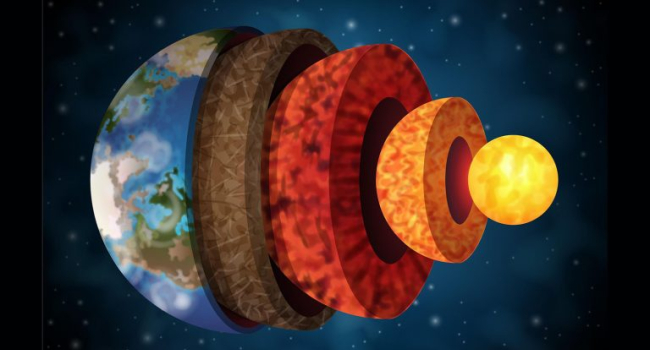
Scientists from the United Kingdom have made a breakthrough in understanding how Earth’s inner core was formed. A study published in Nature Communications shows that carbon played a decisive role in the crystallization of the core billions of years ago. This discovery changes our understanding of the planet’s structure and its magnetic field.
The Mystery of Earth’s Core
Earth’s inner core is a solid iron-rich sphere about 2,400 km in diameter located at the planet’s center. It is surrounded by the liquid outer core, which gradually cools, allowing the inner core to grow through crystallization. But how this process first began had long remained a mystery. Calculations suggested that freezing pure iron under core conditions would require supercooling of 800–1000 °C — something that never occurred in Earth’s history. In reality, scientists estimate the temperature difference did not exceed 250 °C.
The Role of Carbon
A research team led by Alfred Wilson of the University of Leeds carried out atomic-level computer simulations to model crystallization under the extreme pressure and temperature conditions of Earth’s core. They examined the influence of various impurities — silicon, sulfur, oxygen, and carbon — on iron’s ability to form crystals.
The results were unexpected:
- Silicon and sulfur slow down crystallization, making the process more difficult.
- Oxygen has little effect.
- Carbon, in contrast, accelerates iron’s freezing, reducing the required level of supercooling.
Models showed that with 2.4% carbon in the core, supercooling would be about 420 °C, while at 3.8%, only 266 °C. The latter figure most accurately corresponds to real conditions under which the inner core could have begun forming.
Why It Matters
The discovery indicates that Earth’s core contains much more carbon than previously thought. This element not only helped the core crystallize but also played a key role in forming the planet’s magnetic field. The magnetic field shields Earth from solar wind and cosmic rays, creating conditions necessary for life.
“We’ve been given a rare opportunity to glimpse the chemistry of a region of Earth that humanity will never be able to reach directly,” said Alfred Wilson. According to him, carbon became the “secret ingredient” that allowed our planet to take on its current structure.
How the Research Was Conducted
The scientists used advanced computer modeling techniques to recreate the extreme conditions of Earth’s center: pressures millions of times higher than atmospheric levels and temperatures reaching 6,000 °C. They analyzed how impurities affect the behavior of iron atoms, modeling the crystallization process step by step. This allowed them to pinpoint which elements, and in what amounts, could have triggered the formation of the solid core.
What’s Next?
The discovery raises new questions about Earth’s core composition and its evolution. The researchers plan to:
- Carry out additional simulations to refine the proportion of carbon and other elements in the core.
- Study how carbon influenced Earth’s magnetic field dynamics in the past.
- Investigate how similar processes may have occurred on other planets, such as Mars or Mercury.
In Brief
The new study reveals that carbon was the key element that enabled Earth’s inner core to begin forming billions of years ago. A carbon content of 3.8% allowed iron to crystallize under realistic temperatures, shaping both the structure of our planet and its magnetic field. This discovery not only deepens our understanding of Earth but also opens new horizons for studying other planets.