make preferable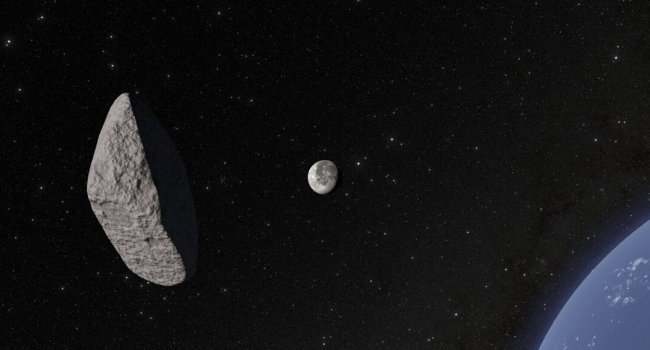
Yesterday, on September 3, 2025, asteroid 2025 QD8 made its closest approach to Earth, passing inside the Moon’s orbit. The Solar Astronomy Laboratory of the Space Research Institute of the Russian Academy of Sciences (IKI RAS) reported this, according to RIA Novosti.
Record-Breaking Approach
The asteroid approached Earth at about 6:00 p.m. Moscow time, flying at a distance of around 200,000 kilometers — just 0.6 of the distance to the Moon. Scientists emphasized that there was no threat to our planet, as the asteroid’s trajectory did not intersect with Earth. At present, the object is still inside the Moon’s orbit but is gradually moving away.
“There was no danger for Earth,” IKI RAS clarified.
What Is Known About the Asteroid?
- Size: 2025 QD8 has a diameter of about 22 meters, comparable to the Chelyabinsk meteorite, which entered Earth’s atmosphere on February 15, 2013, and exploded at an altitude of 23.3 km, causing significant damage in Chelyabinsk.
- Discovery: The asteroid was first detected on August 18, 2025, by the international Virtual Telescope Project. Nothing was known about it before.
- Classification: 2025 QD8 belongs to the Apollo group — near-Earth asteroids whose orbits cross Earth’s orbit from the outside.
- Speed: The object was moving at about 45,000 km/h, allowing it to pass Earth quickly.
Why Is This Important?
The close approach of asteroid 2025 QD8 is a rare event that highlights the importance of monitoring near-Earth objects. Although this asteroid posed no threat, its size is comparable to the Chelyabinsk meteorite, which, upon entering the atmosphere, created a powerful shockwave that damaged buildings and injured people. If 2025 QD8 had entered the atmosphere, most of its mass likely would have burned up, but small fragments could have reached the surface.
Observing the Asteroid
The international Virtual Telescope Project broadcast the asteroid’s flyby live, starting on September 3 at 2:00 a.m. Kyiv time. Using the 17-inch “Elena” telescope, astronomers captured images of 2025 QD8 when it was still about 3.9 million km from Earth. In the photos, the asteroid appeared as a tiny glowing dot among the stars.
What Else You Should Know
Asteroids the size of 2025 QD8 are not classified as potentially hazardous, since their diameter is under 140 meters and their approach distance is more than 7.5 million km. However, such events remind us of the need for continuous space monitoring. NASA and other space agencies track tens of thousands of near-Earth objects, and according to their data, no collisions with large asteroids are expected in the next 100 years.
Nonetheless, scientists continue developing planetary defense technologies. For example, in 2022, NASA successfully carried out the DART mission, altering the orbit of the asteroid Dimorphos by colliding a spacecraft with it. This demonstrated the possibility of changing the trajectories of hazardous objects in the future.
In Summary
The flyby of asteroid 2025 QD8, at just over 200,000 kilometers from Earth, became a significant astronomical event, showing how close cosmic objects can pass by us. Although there was no danger, the event underscores the importance of observation and preparedness for potential risks. Scientists will continue studying the trajectory and composition of 2025 QD8 to better understand the nature of near-Earth asteroids.