make preferable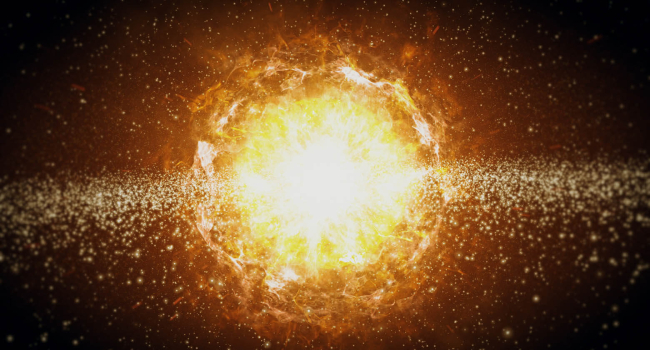
Space has always fascinated humanity with its mystery. But what if it not only inspires us, but also directly shapes our history? Francis Thackeray, a scientist from South Africa, has put forward a bold hypothesis: supernova explosions may have been one of the key factors in human evolution. His ideas, published on The Conversation, offer a new perspective on the connection between the cosmos and life on Earth.
Traces of a Supernova on Earth
About 3 to 2.6 million years ago, Earth went through an unusual event. Scientists discovered traces of the rare isotope iron-60 (Fe-60) in marine sediments from that time. This isotope is formed during a supernova explosion and released into space. The period coincides with significant changes on our planet: the climate became colder, and ecosystems began to transform. At that time, some australopithecine species went extinct, while the first members of the genus Homo — our direct ancestors — appeared.
Thackeray suggests that a supernova that exploded relatively close to Earth may have been the catalyst for these changes. But how could a star, millions of kilometers away, affect life on Earth?
Cosmic Rays and Earth’s Climate
A supernova explosion is accompanied by a burst of powerful cosmic rays, which, according to Thackeray, may have drastically altered Earth’s conditions. Here’s how it could have worked:
- Ozone layer destruction: Cosmic rays may have damaged the ozone layer, increasing ultraviolet radiation and cooling the climate.
- Increased cloudiness: The rays could have promoted cloud formation, reinforcing cooling and changing rainfall patterns.
- Ecosystem transformation: Cooling led to shrinking forests and expanding savannas in Africa, where our ancestors lived. Hominins had to adapt: finding new food sources, traveling longer distances, and developing new skills.
These changes created evolutionary pressures that may have pushed forward the development of the first humans.
Mutations and the Birth of Homo
Thackeray goes further, suggesting that cosmic rays may have influenced not only the environment but also the genetics of ancient hominins. Intense radiation, he argues, could have caused DNA mutations that accelerated speciation. He links supernova events to two key moments in evolution:
- 7 million years ago: The split between human and chimpanzee evolutionary lines, marked by Sahelanthropus tchadensis, one of the earliest known hominins.
- 2.8 million years ago: The transition from australopithecines to the genus Homo, including the emergence of Homo habilis, who already made simple tools.
These mutations may have contributed to brain development, improved motor skills, and other traits that made humans unique.
Science or Science Fiction?
Thackeray’s hypothesis is based on real data: traces of iron-60 in sediments confirm that Earth was exposed to a supernova about 3 million years ago. However, the idea remains controversial. Some scientists argue that additional evidence is needed to prove the link between supernovas and evolution. For example:
- Climate changes may have been caused not only by supernovas but also by volcanic activity or natural orbital variations of Earth.
- Genetic mutations could have occurred without external radiation, driven purely by natural selection.
Further studies of geological deposits and ancient hominin genomes are required to test the theory. Still, Thackeray’s idea is intriguing, as it connects astronomy, climatology, and anthropology.
Why It Matters
If the hypothesis is correct, it reshapes our understanding of evolution. The cosmos is no longer just a distant backdrop — it becomes an active participant in the story of life on Earth. This raises new questions: Could supernovas have influenced the development of life on other planets? And how do cosmic events shape the future of our own planet?
What’s Next?
To test the hypothesis, scientists plan to:
- Study more geological deposits for isotopes linked to supernovas.
- Conduct genetic research to look for mutations caused by cosmic radiation.
- Use modern technology to model the effects of supernovas on climate and the biosphere.
In Summary
Francis Thackeray’s hypothesis offers a fascinating view of human evolution. Supernova explosions millions of years ago may have changed Earth’s climate, ecosystems, and even the DNA of our ancestors, paving the way for the emergence of the genus Homo. While further evidence is needed, the theory highlights the profound connection between the cosmos and life. Perhaps we are not only children of Earth, but also heirs of distant stars.