make preferable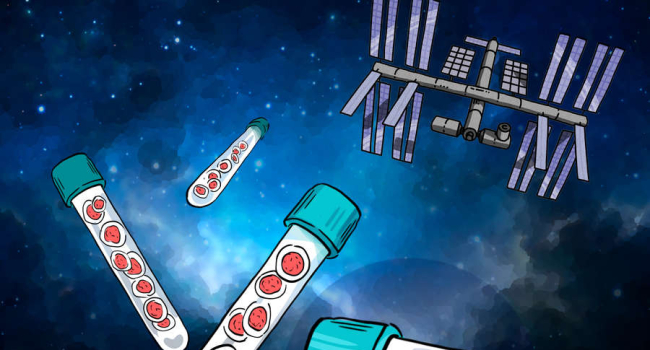
As humanity advances in space exploration, the question of reproduction beyond Earth is becoming increasingly relevant. Spaceflight affects many bodily functions, including the reproductive system. A new study by Japanese scientists from Kyoto University, published in Stem Cell Reports in August 2025, shows that reproduction in space may indeed be possible. An experiment with mouse spermatogonial stem cells has yielded promising results.
The experiment: spermatogonia in space
Scientists froze mouse spermatogonial stem cells (the cells responsible for producing sperm in the testes) using cryopreservation and sent them to the International Space Station (ISS) for six months. After returning to Earth, the cells were transplanted back into the testes of mice. Several months later, following natural mating, healthy offspring were born with normal levels of gene expression.
To the researchers’ surprise, space conditions — microgravity and radiation — did not affect the cells’ ability to remain preserved in their frozen state or to perform their functions. “It is important to understand how long we can store reproductive cells on the ISS to determine the limits of preservation for future space missions,” noted Mito Kanatsu-Shinohara, the study’s lead author from Kyoto University.
Why is this important?
Spermatogonial stem cells play a key role in reproduction, and their resilience in space opens the door to preserving reproductive material during long missions. This is especially critical for future expeditions to the Moon, Mars, or more distant destinations, where humanity will need autonomous reproductive capability.
However, the study also highlights that other reproductive technologies, such as embryo freezing, may be less effective in space. Previous work has shown that embryos (the early stage after egg fertilization) are highly sensitive to space conditions and often develop abnormally. Similarly, dried sperm (stored without supportive cells) may pose risks to offspring health, making the study of spermatogonial cells a priority.
Reproduction in space: what do we know?
So far, research on reproduction in space is limited to animal experiments, and data on women are even scarcer due to the small number of female astronauts. It is known that menstruation (the bleeding phase of the menstrual cycle) occurs in space without major changes. However, the effects of microgravity and radiation on follicular development (the maturation of eggs) and ovulation (the release of an egg) in humans remain largely unknown. As space gynecologist Dr. Varsha Jain noted in an article for BBC Science Focus, reproductive research is often insufficient even on Earth, and questions about conception and childbirth in space remain purely theoretical.
Prospects and challenges
The success of the mouse experiment is an important step toward understanding how humanity might reproduce beyond Earth. Key future tasks include:
- Studying the long-term storage of reproductive cells in space.
- Investigating the female reproductive system under microgravity and radiation.
- Developing safe reproductive methods for long-duration space missions.
These efforts will help prepare humanity for life on other planets, where autonomous reproduction will become a necessity.
In summary
The experiment with mouse spermatogonial stem cells on the ISS demonstrated that space conditions do not prevent their preservation and functionality, opening the way for reproduction beyond Earth. The birth of healthy mouse offspring confirms that cryopreservation could be a reliable method for future space missions. However, questions about female reproduction and embryo development in space require further research. This breakthrough brings us closer to understanding how humanity may continue its lineage in space, making the colonization of other worlds more realistic.