make preferable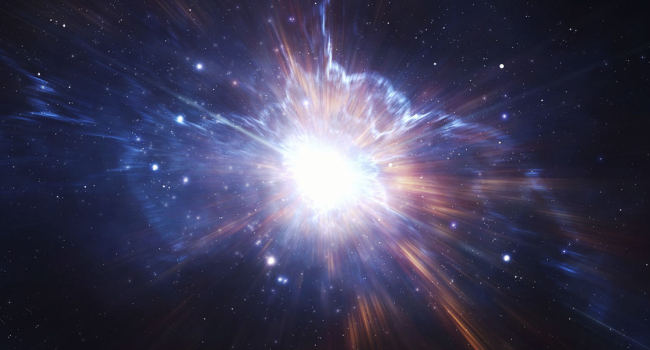
In the first instants after the Big Bang, the Universe experienced a colossal upheaval, traces of which still reverberate through space. These “echoes”—gravitational waves—may hold the key to unlocking the mysteries of the Universe’s birth. Scientists hope that in the coming decades, new space observatories will be able to detect them, offering an unprecedented glimpse into the dawn of cosmic history.
Gravitational Waves: Elusive Traces of the Cosmos
In 1916, Albert Einstein predicted the existence of gravitational waves—ripples in the fabric of spacetime caused by the acceleration of massive objects. But because gravity is so weak compared to other forces, Einstein believed these waves could never be observed. Nearly a century later, in 2015, the Laser Interferometer Gravitational-Wave Observatory (LIGO) proved otherwise, detecting waves from the merger of black holes. These events release staggering amounts of energy—comparable to the mass of the Sun being converted into energy in a fraction of a second—but in the form of invisible radiation: gravitational waves.
Despite their power at the moment of origin, these waves are only a faint hint of the most monumental gravitational waves the Universe ever produced: primordial gravitational waves, born in the first instants of the Big Bang.
Inflation: The Birth of the Universe
Cosmologists propose that less than a fraction of a second after the Big Bang, the Universe underwent inflation—a rapid expansion that increased its size billions of times. This event set the foundation for all subsequent cosmic history. Yet what triggered inflation, why it began, and why it ended remain profound mysteries.
Inflation left behind subtle variations in density that later seeded the formation of galaxies. These variations can still be seen in the cosmic microwave background (CMB)—radiation released about 380,000 years after the Big Bang. Tiny fluctuations in the CMB’s temperature support the theory of inflation, but direct proof of the event remains elusive.
Inflation also generated powerful gravitational waves, which still exist but have been greatly weakened by the Universe’s expansion over billions of years. Their long wavelengths and faint intensity make them extraordinarily difficult to detect.
Why LIGO Can’t Detect Them
LIGO is designed to detect short, sharp gravitational waves from black hole mergers, which stand out against background noise such as seismic vibrations—or even conversations in a cafeteria nearby. Primordial gravitational waves, however, are too slow and too stretched out to be caught by ground-based instruments. They are buried beneath background noise, requiring a new generation of detectors.
The Hope of LISA
In the mid-2030s, the European Space Agency (ESA) plans to launch LISA (Laser Interferometer Space Antenna), a space-based observatory composed of three satellites separated by 1 to 5 million kilometers. The satellites will exchange laser beams to monitor minute shifts in distance caused by gravitational waves. LISA will search for signals from supernovae, mergers of supermassive black holes, and—possibly—primordial waves from inflation.
However, success is not guaranteed. Scientists do not yet know how strong these primordial waves were at their birth, or how much they have weakened today. If LISA detects them, it would provide the first direct glimpse of the Universe’s earliest moments.
The Dream of the Big Bang Observer
An even more ambitious project, the Big Bang Observer (BBO), was proposed more than a decade ago. It envisions dozens of satellites linked by ultraprecise lasers, spread across the Solar System. Such a system could detect virtually any primordial gravitational waves predicted by inflation theories. For now, though, BBO remains only a concept with no concrete plans for implementation.
Why It Matters
Detecting primordial gravitational waves would revolutionize cosmology. It would allow scientists to:
- Confirm the theory of inflation.
- Reveal details of its mechanism: what triggered it, and why it ended.
- Deepen our understanding of the physics of the Universe’s first moments.
Such a discovery would fundamentally reshape our view of the cosmos, bringing us closer to solving the mystery of its origin.
In Brief…
Gravitational waves from the Big Bang are a faint but unique imprint of inflation, the event that determined the fate of the Universe. While ground-based observatories like LIGO cannot detect them, hope rests on LISA, scheduled for launch in the 2030s. If successful, it would provide direct evidence of inflation and open a window onto the Universe’s very first instants. An invisible but transformative vision, it would forever change our understanding of the cosmos.