make preferable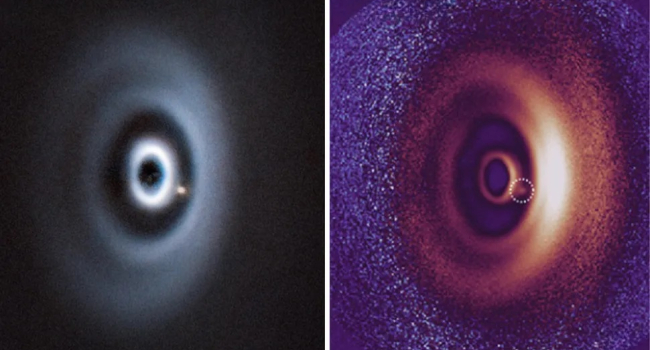
An international team of astronomers has made a stunning discovery: a young exoplanet, “feeding” on material around a Sun-like star, has been found 430 light-years from Earth. The planet, named WISPIT 2b, is the first confirmed exoplanet ever detected within a multi-ringed protoplanetary disk. The findings were published on August 26, 2025, in two papers in The Astrophysical Journal Letters.
WISPIT 2b: A Young Giant Planet
WISPIT 2b is a gas giant roughly the size of Jupiter and only 5 million years old, making it a true “infant” compared to our Solar System, which is 4.6 billion years old. The planet is actively accreting material from its protoplanetary disk — a ring of gas and dust around its star WISPIT 2 — carving out distinct gaps and channels in the disk, much like a cosmic Pac-Man.
The disk itself, resembling a vinyl record with multiple rings and voids, spans 380 astronomical units (one AU is the distance between Earth and the Sun). WISPIT 2b is only the second young planet found around a Sun-like star, making this system an ideal laboratory for studying how planets interact with their disks and how planetary systems evolve.
“Finding this planet has been an incredible experience — we were very lucky,” said lead researcher Richell van Kapelleveen from Leiden University. “WISPIT 2, a young version of our Sun, belongs to a little-studied group of young stars, and we did not expect to come across such an impressive system. It will likely become a benchmark for research for years to come.”
How Was WISPIT 2b Discovered?
The planet was first spotted using the Very Large Telescope (VLT) in Chile’s Atacama Desert. The team conducted brief observations — only a few minutes per star — to look for faint glimmers of planets. In the case of WISPIT 2, they unexpectedly detected a striking multi-ringed dust disk.
“We were taking quick snapshots of many young stars to search for the faint glow of planets,” explained Christian Ginski, a lecturer at the University of Galway’s School of Natural Sciences. “But with this star, we stumbled upon a stunningly beautiful multi-ringed disk. Once we saw it, we immediately decided to follow up with more observations to check for a planet.”
Infrared images from the VLT revealed WISPIT 2b glowing within one of the disk’s gaps. Still hot from its formation, the planet’s residual heat made it visible. Meanwhile, a team from the University of Arizona also detected the planet in the optical range, confirming that it is actively accreting material.
Why Is This Discovery Important?
WISPIT 2b is the first confirmed exoplanet found in a multi-ringed protoplanetary disk, giving astronomers a rare opportunity to study planetary formation in action.
“Imaging forming planets is extremely challenging, and this discovery offers us a chance to understand why thousands of known exoplanetary systems look so different from our Solar System,” noted Ginski.
The finding also highlights the role of a new generation of researchers. “This is a remarkable discovery. When Dr. Ginski first showed me the image, I could hardly believe it was real,” said Jake Byrne, a master’s student at the University of Galway. “It’s a major breakthrough that will certainly spark discussions in the scientific community and push forward our understanding of planetary formation.”
In Brief…
The discovery of WISPIT 2b in the multi-ringed protoplanetary disk of star WISPIT 2 marks a breakthrough in planetary science. This young, actively accreting exoplanet provides a unique glimpse into the processes that, billions of years ago, gave rise to our own Solar System. The WISPIT 2 system promises to become a key target for future research, shedding light on the birth of planets and the diversity of planetary systems across the universe.