make preferable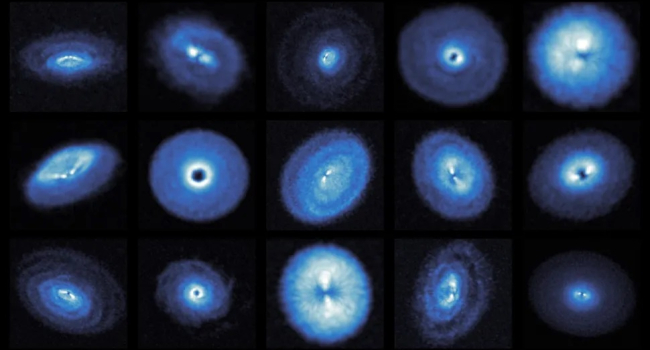
A new study conducted with the ALMA radio telescope (Atacama Large Millimeter/submillimeter Array) has revealed subtle warps in protoplanetary disks around young stars, which may explain why the orbits of planets in our Solar System are tilted at different angles. The findings, published on August 27, 2025, in The Astrophysical Journal Letters, shed light on the processes of planet formation.
Discovery of Disk Warps
According to space.com, the team led by Andrew Winter of Queen Mary University of London, as part of the exoALMA program, studied 15 protoplanetary disks—clouds of gas and dust from which planets form. Using the Doppler effect, scientists measured the speed and direction of carbon monoxide (CO) gas in these disks. CO is an excellent tracer of disk structure, as it emits a strong signal in the submillimeter range, which ALMA can detect.
The measurements showed that the tilt of the disks varies between 0.5 and 2 degrees. “Our results indicate that protoplanetary disks are slightly warped,” Winter noted. “This radically changes our understanding of these objects and has important implications for the processes of planet formation.”
Warped Disks Versus the Ideal Model
Until recently, protoplanetary disks were thought to be flat, orderly torus-shaped structures neatly rotating around young stars. However, the observed warps suggest that these disks are far from perfectly aligned. Possible causes of such warping remain uncertain:
• Gravitational influence from a companion star, creating tidal forces that affect different parts of the disk.
• Chaotic mixing of material, leading to interactions between regions of gas and dust within the disk.
Connection to Planet Formation
The researchers found that the rate at which material from the disk flows onto the young star—helping it grow—is linked to the characteristics of the warps. This indicates a dynamic connection between the inner disk, where the star accretes matter, and the outer regions, where planets form and distortions appear. In simulations, Winter’s team showed that warps can:
• Create spiral patterns in some disks.
• Cause temperature variations of up to 10 °C between different disk regions.
These warps also resemble the orbital tilts of planets in our Solar System. For example, Earth’s orbit is tilted 7.25° relative to the Sun’s equator, Mars’s by 5.65°, and Jupiter’s by 5.51°. “Such small tilts may be a common outcome of star and planet formation,” Winter remarked.
Significance for Planet Formation
The discovery of warps in protoplanetary disks adds a new parameter to models of planet formation. These distortions may influence how planets form and settle into their orbits. By accounting for disk tilts, scientists can better understand how Earth and other planets in the Solar System acquired their orbital characteristics billions of years ago.
In Brief…
The study of protoplanetary disks with ALMA shows that their warps may be the key to understanding the orbital tilts of planets in our Solar System. The detected inclinations of 0.5 to 2 degrees highlight the dynamic and disordered nature of disks, shaping planet formation. These findings open new possibilities for theorists, helping refine models of planetary system birth and bringing us closer to solving the mystery of our own system’s origins.