make preferable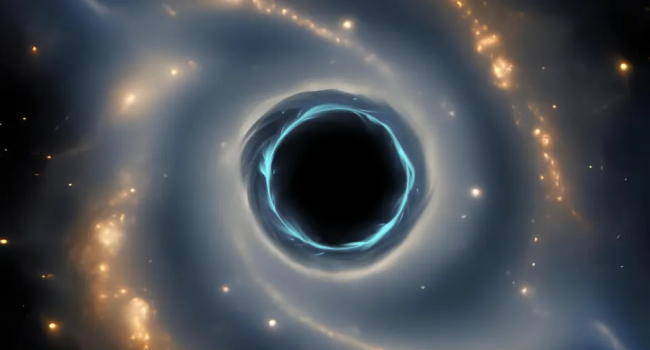
Astronomers led by Maciej Rybak from Leiden University have made a groundbreaking discovery, detecting radiation near the supermassive black hole of a quasar located in the galaxy RXJ1131-1231, some 6 billion light-years from Earth. This achievement was made possible thanks to gravitational lensing — a phenomenon predicted by Albert Einstein in his 1915 general theory of relativity — and a fortunate cosmic alignment. The results were published on August 21, 2025, in Physical Review Letters.
Gravitational Lensing: Double Magnification
The galaxy RXJ1131-1231, home to an active quasar, has long been a favorite target for astronomers due to gravitational lensing. This effect occurs when a massive object — in this case, another galaxy — sits between Earth and the light source being observed. The mass bends spacetime, altering the path of the quasar’s light, making RXJ1131-1231 appear three times larger than it would without lensing (a process called macrolensing).
However, in this discovery, microlensing also played a key role. This subtler effect is caused by smaller objects, such as stars, within the lensing galaxy. Using the Atacama Large Millimeter/submillimeter Array (ALMA) in Chile’s Atacama Desert, Rybak’s team identified three distinct images of RXJ1131-1231, each fluctuating in brightness independently. “That’s a clear sign of microlensing,” Rybak explained. “We immediately knew we had to dig deeper.”
The combination of macro- and microlensing created a “double magnification” effect, which Rybak compared to stacking two magnifying glasses. This allowed scientists to examine details of the quasar that would normally remain hidden across such vast distances.
Unexpected Millimeter-Wavelength Emission
The project began in 2015 as a search for cold gas in RXJ1131-1231. By 2020, repeated observations revealed that the quasar’s brightness flickered over years — but in the millimeter wavelength range. This was surprising, since such emission is typically linked to cold gas and dust, not the energetic regions surrounding a black hole.
The team proposed that the millimeter radiation originates from the corona — a hot, strongly magnetized torus-shaped region encircling the supermassive black hole. This is the first-ever detection of millimeter emission being microlensed, making the finding truly unique. Rybak’s group, known for pioneering optical microlensing studies back in 2008, has now extended the frontier into the millimeter domain.
What Comes Next?
The researchers plan to follow up with NASA’s Chandra X-ray Observatory to measure the temperature and magnetic field strength near the black hole. These insights could refine models of how supermassive black holes influence their host galaxies.
“This discovery lets us peer into the heart of a quasar and better understand how the most extreme objects in the universe operate,” Rybak noted. The ongoing study of RXJ1131-1231 promises to shed light on galaxy evolution and the pivotal role of black holes in shaping cosmic environments.
In Brief
The detection of emission near the supermassive black hole in RXJ1131-1231, enabled by the rare combination of macro- and microlensing, underscores both Einstein’s brilliance and the power of modern instruments like ALMA. The discovery of millimeter-wavelength emission from the quasar’s corona opens a new window into black hole physics and their galactic impact. Published in Physical Review Letters, this work marks a significant milestone that will inspire future advances in astrophysics.