make preferable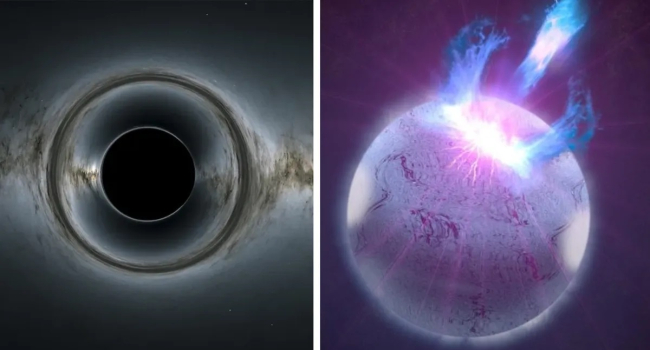
A new study published on August 20, 2025, in Physical Review D suggests that dark matter may accumulate in the cores of Jupiter-sized planets, forming microscopic black holes that gradually consume these worlds from the inside out. This bold hypothesis, proposed by researchers at the University of California, Riverside, opens up new possibilities for studying mysterious dark matter through exoplanets, according to Space.com.
How Does Dark Matter Create Black Holes?
Dark matter, which makes up about 85% of the universe’s total mass, remains one of science’s greatest mysteries. It does not interact with light, making it invisible and ruling out ordinary particles like electrons, protons, and neutrons as its constituents. Scientists believe dark matter could consist of various hypothetical particles, and the new model focuses on superheavy particles that do not annihilate when colliding with one another.
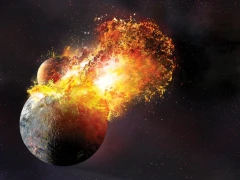
According to the theory, such dark matter particles may be captured by the gravity of exoplanets, lose energy, and settle in their cores. Over time, their density increases until they collapse into a tiny black hole. This black hole then begins to “devour” the planet, eventually turning it into a black hole with the same mass as the original planet — about 0.001 solar masses for Jupiter-sized worlds.
“If dark matter particles are heavy enough and do not annihilate, they may eventually collapse into a microscopic black hole,” explained lead author Mehrdad Foroutan-Mehr of UC Riverside.
Limits of the Model
The model only works under certain conditions:
- Dark matter particles must be superheavy, ruling out the popular candidate axion, a hypothetical lightweight particle.
- The particles must not annihilate when they meet, unlike electrons and positrons, otherwise they would never accumulate in sufficient amounts to form a black hole.
How These Black Holes Differ from Stellar Ones
The lightest known black holes are stellar in origin, ranging from 3 to 100 solar masses. They form when massive stars collapse after a supernova, as the star’s core compresses under its own gravity. To achieve this, the progenitor star must exceed the Chandrasekhar limit (1.4 solar masses), and its core after collapse must surpass the Tolman–Oppenheimer–Volkoff limit (2.2–2.9 solar masses). For example, the lightest discovered black hole has a mass of 3.8 solar masses, while the heaviest neutron star weighs in at 2.4 solar masses.
By contrast, black holes born inside exoplanets from dark matter would be much lighter — their mass would match that of the planet, such as Jupiter. This makes them unique cosmic objects that could potentially be detected through exoplanet observations.
“The discovery of a black hole with the mass of a planet would be a breakthrough,” noted Foroutan-Mehr. “If astronomers find a population of such objects, it would strongly support the model of superheavy, non-annihilating dark matter.”
Exoplanets as Dark Matter Detectors
The study proposes that exoplanets, especially those in regions with high dark matter density such as the galactic center, could act as natural laboratories for probing this elusive substance. Dark matter accumulation might cause planets to heat up or emit high-energy radiation, which in theory could be observed.
“On gas giant exoplanets of varying sizes, temperatures, and densities, black holes could form within observable timescales — possibly even creating several black holes during the lifespan of a single planet,” added Foroutan-Mehr.
However, current telescopes lack the sensitivity to detect such signals. Future missions and next-generation instruments may open this observational window, offering fresh insights into dark matter.
Other Approaches to Dark Matter Research
Exoplanets are not the only candidates for dark matter studies. For instance, dark matter may also accumulate in neutron stars, heating them through particle annihilation. If astronomers were to find an old, cold neutron star, it could rule out certain dark matter properties, since theoretically such stars should remain warm.
“If we find an old and cold neutron star, it could exclude certain characteristics of dark matter,” explained Foroutan-Mehr.
Why It Matters
Dark matter remains a central puzzle in cosmology. It shapes galaxies through its gravity yet stays invisible to direct detection. If the theory of planet-mass black holes formed from dark matter proves true, it would:
- Provide a new way to detect dark matter through exoplanet observations.
- Confirm the existence of superheavy dark matter particles.
- Transform our understanding of planetary interiors and evolution.
With over 5,000 confirmed exoplanets already cataloged, they are becoming increasingly valuable tools for cosmological research.
In Brief
A new study in Physical Review D suggests that dark matter may accumulate in the cores of Jupiter-sized exoplanets, forming black holes that consume them from within. These planet-mass black holes are far lighter than stellar ones and could be detected through exoplanet studies, particularly in dark matter–rich regions. The theory excludes light particles such as axions and requires superheavy, non-annihilating particles. If confirmed, this hypothesis could revolutionize our understanding of dark matter, planetary evolution, and the cosmos itself.