make preferable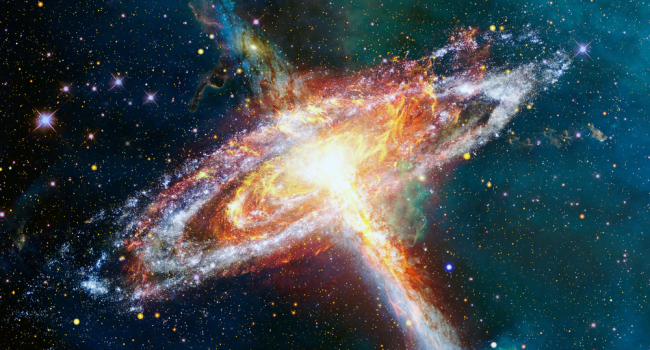
An international team of scientists has developed a new approach to studying the earliest stages of the Universe, which could shed light on the mystery of what happened before the Big Bang. By using numerical relativity—complex computer simulations that solve Einstein’s equations under extreme conditions—researchers hope to peer into the epoch that may have preceded the birth of our Universe. The study was published in Living Reviews in Relativity (LRR) on August 24, 2025.
A New Approach to an Old Mystery
The question of what existed before the Big Bang remains one of the greatest enigmas in cosmology. Traditional models suggest the Universe began about 13.8 billion years ago with a singularity—a point of infinite density. However, classical methods of solving Einstein’s general relativity equations often simplify reality by assuming uniformity and isotropy in the early Universe. These assumptions make calculations easier but fail to capture the potential complexity of actual events.
“You can search for solutions ‘under the streetlight,’ but beyond its reach—in the darkness—the equations cannot be solved by classical methods. Numerical relativity allows us to look into those regions where it was impossible before,” explained study co-author Eugene Lim of King’s College London.
Numerical relativity makes it possible to simulate intricate scenarios without relying on simplifications. Using powerful computers, scientists model gravitational and cosmological processes under conditions close to the moment of the Big Bang, including irregularities and anisotropy.
What Can Be Simulated?
The new method opens the door to exploring several key hypotheses:
- Cosmic Inflation: A period of rapid expansion in the first fractions of a second after the Big Bang. Simulations may reveal how irregularities influenced this process.
- Cosmic Strings: Hypothetical one-dimensional defects in spacetime that could have formed in the early Universe.
- Multiverse: Possible collisions between our Universe and others within the multiverse hypothesis.
- Cyclic Models: Theories suggesting the Universe undergoes recurring cycles of “big bangs” and “collapses.”
These simulations may show whether the Universe existed in some form before the Big Bang or support cyclic models where our Universe is just one in an endless sequence.
Achievements of Numerical Relativity
The method has already proven effective. For example, it enabled predictions of gravitational wave signals from black hole mergers, which formed the basis for the LIGO experiment that first detected such waves in 2015. Now, researchers hope to apply the same approach to cosmology in order to answer fundamental questions about the Universe’s origins.
“Previously, numerical relativity was successfully applied to predict gravitational wave signals from black hole mergers—this laid the groundwork for the LIGO experiment. Now scientists hope the same method will open a path toward understanding whether the Universe existed before the Big Bang,” the study notes.
Why It Matters
The Big Bang is considered the beginning of space and time, but theories about what came before remain speculative. Some suggest a “pre-universe” or a quantum state from which our world emerged. Numerical simulations provide a way to test such ideas by modeling extreme conditions inaccessible to direct observation.
If the method proves successful, it could:
- Confirm or disprove cyclic models of the Universe.
- Reveal traces of cosmic strings or other exotic objects.
- Provide insights into the nature of the multiverse.
In Brief
Scientists have proposed a groundbreaking way to study what may have existed before the Big Bang using numerical relativity. By solving Einstein’s equations without simplifications, computer simulations can model complex scenarios of the early Universe, including inflation, cosmic strings, and the multiverse. Published in Living Reviews in Relativity, the research builds on the method’s success in predicting gravitational waves and may pave the way toward solving one of the greatest cosmological mysteries: the origin of our Universe.