make preferable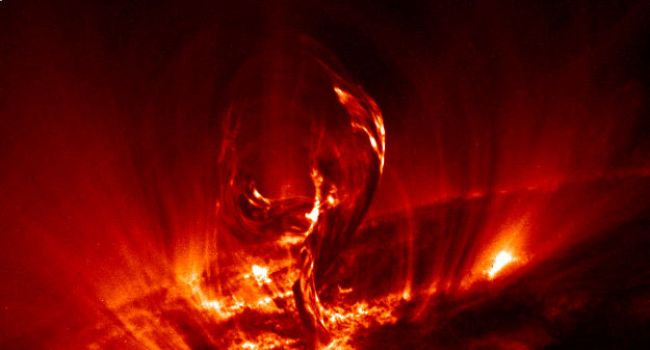
On August 20, 2025, the Solar Astronomy Laboratory of the Space Research Institute (IKI) of the Russian Academy of Sciences reported a powerful solar eruption — one of the largest prominences in recent years. The event, recorded near the Sun’s south pole, highlights the star’s activity during the solar maximum. Here’s what happened and what it could mean for Earth.
What Happened?
A prominence is a giant plasma structure, made of charged hydrogen and helium, held in place by magnetic fields in the Sun’s corona. In this case, the eruption began around 7:00 a.m. Moscow time, when scientists first noticed signs of destabilization. By 10:00 a.m., the structure had completely detached from the Sun’s surface, stretching to a size larger than the star itself — about 1.5 million kilometers.
Part of the plasma failed to overcome solar gravity and will soon fall back as “fire rain” — streams of hot matter returning to the surface. However, most of the plasma escaped into interstellar space, interacting with galactic gas.
The Danger of Prominences
Prominences are considered among the most dangerous space weather events because their eruptions, known as coronal mass ejections (CMEs), can trigger powerful geomagnetic storms if they hit Earth’s magnetic field. Such storms can:
- Disrupt satellites and GPS systems.
- Cause failures in power grids.
- Intensify auroras.
The probability of a prominence hitting Earth is relatively low, since they move in random directions. In this case, early data indicates the plasma was ejected away from our planet.
“In this instance, the plasma appears to have moved away from Earth. The last direct hit by a major prominence was recorded on June 1 this year, when it caused an almost three-day geomagnetic storm that came close to reaching the highest fifth level,” reported the Solar Astronomy Laboratory at IKI RAS.
Context of Solar Activity
This event occurred during the peak of Solar Cycle 25, which began in 2024 and, according to NASA forecasts, will last until mid-2026. In August 2025, scientists also observed the growth of a large coronal hole on the Sun, which increases the speed of the solar wind and could trigger geomagnetic storms within the next 7–10 days. This makes current solar activity particularly significant for monitoring.
Earlier, on August 12, 2025, the Laboratory reported another major prominence that was also not directed at Earth but still underlined the intensification of solar activity.
Why It Matters
Prominences and associated CMEs are of great scientific interest because they:
- Help researchers study solar activity and its effect on space weather.
- Improve models for predicting geomagnetic storms.
- Are important for protecting technologies, including satellites, power grids, and aviation at high latitudes.
Although this particular eruption does not pose a threat to Earth, it emphasizes the need for constant solar monitoring, especially during the solar maximum, when such events occur more frequently.
In Brief
The Sun released one of the largest prominences in recent years, reaching a size of 1.5 million kilometers. The event, recorded on August 20, 2025, near the star’s south pole, was not directed at Earth, lowering the risk of geomagnetic storms. However, it highlights the heightened solar activity of Cycle 25, which requires close scientific attention. The Solar Astronomy Laboratory of IKI RAS continues to track such phenomena to minimize potential technological risks and deepen our understanding of the Sun’s behavior.