make preferable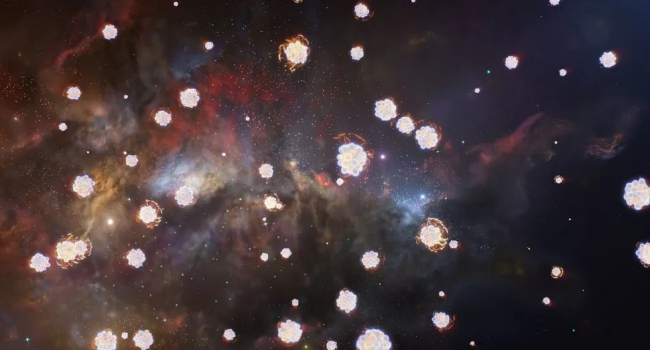
For the first time, scientists have managed to recreate the earliest molecules of the Universe — helium hydride ions (HeH+), which played a key role in the formation of the first stars. An experiment conducted under conditions simulating the early Universe revealed unexpected results that call for a rethinking of the chemical processes behind star formation. The study, published on July 24, 2025, in the journal Astronomy and Astrophysics, provides new insights into the birth of stars hundreds of millions of years after the Big Bang.
The First Molecules of the Universe
After the Big Bang 13.8 billion years ago, the Universe was incredibly hot. Within a few seconds, the temperature dropped, allowing the first elements — hydrogen and helium — to form. Hundreds of thousands of years later, as the temperature fell further, atoms began to combine with electrons, creating the first molecules. The helium hydride ion (HeH+) is considered the very first molecule in the Universe, essential for the formation of molecular hydrogen (H₂) — the most common molecule today.
These molecules played a crucial role in the emergence of the first stars hundreds of millions of years later. For nuclear fusion to begin in protostars, atoms and molecules must collide, releasing heat. This process is inefficient at temperatures below 10,000 °C, but HeH+ ions can sustain reactions even under colder conditions, making them an important factor in star formation.
The Experiment: Recreating the Early Universe
Scientists from the Max Planck Institute for Nuclear Physics in Germany carried out an experiment to study the behavior of helium hydride ions. They:
- Cooled HeH+ ions to −267 °C and stored them for up to 60 seconds.
- Collided them with heavy hydrogen (deuterium), simulating conditions under which nuclear fusion began in protostars.
- Analyzed how temperature affects reaction rates.
The results surprised researchers: the reaction rates between HeH+ ions and hydrogen did not decrease at low temperatures, contrary to previous theories. “It was previously believed that the likelihood of reactions significantly drops at low temperatures, but neither the experiment nor new calculations confirmed this,” noted study co-author Holger Kreckel.
Why This Matters
The discovery reshapes our understanding of the role of helium hydride ions in the early Universe:
- Greater significance: Reactions with HeH+ turned out to be “much more important for the chemistry of the early Universe than previously thought.” This means the ions may have accelerated star formation even under cold conditions.
- Revision of models: The new data requires a reevaluation of chemical processes tied to the formation of the first stars. The abundance of HeH+ ions could have influenced the speed and efficiency of star formation.
- Broader implications: The findings may affect models of early Universe evolution, including the formation of galaxies and the distribution of molecular hydrogen.
Context and Outlook
Helium hydride ions were first detected in space in 2019 using the SOFIA telescope, confirming their existence after decades of theoretical predictions. The new experiment marks the first time these molecules have been recreated in laboratory conditions that mimic the early Universe. This achievement opens the door to further research:
- Studying other molecules, such as molecular hydrogen, and their roles in star formation.
- Refining models of the chemical evolution of the Universe.
- Applying the data to telescope observations, such as those from the James Webb Space Telescope, to search for traces of early molecules in space.
In Brief…
Scientists have recreated helium hydride ions (HeH+), the Universe’s first molecules, and found that their reactions do not slow down at low temperatures, contrary to older theories. The study, published on July 24, 2025, in Astronomy and Astrophysics, shows that HeH+ played a more important role in star formation than previously believed. This discovery forces a reconsideration of early Universe chemistry and highlights how laboratory experiments can uncover cosmic mysteries, reshaping our understanding of its evolution.