make preferable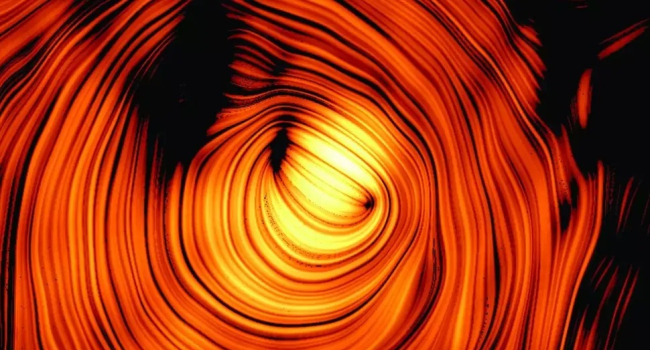
Astronomers have created a striking image of the blazar PKS 1424+240, reminiscent of the “Eye of Sauron” from The Lord of the Rings. This object, located billions of light-years from Earth, has been studied with the Very Long Baseline Array (VLBA) radio telescope for 15 years. The resulting image reveals the unique features of the blazar, which has turned out to be one of the brightest sources of gamma rays and cosmic neutrinos. Here is what makes PKS 1424+240 so special and why it matters for science.
What is Blazar PKS 1424+240?
A blazar is a type of quasar — an active galactic nucleus powered by a supermassive black hole. Quasars emit enormous amounts of electromagnetic energy, outshining all the stars in their galaxy. Blazars are distinguished by their powerful relativistic jets — streams of particles moving at nearly the speed of light — that are pointed toward Earth (within about 10 degrees). This orientation creates an apparent brightness boost of 30 times or more, though it does not make them more dangerous for us; it’s simply a matter of viewing angle.
PKS 1424+240, discovered through its high neutrino emission levels by the IceCube Observatory at the South Pole, stands out even among other blazars. Its image, based on VLBA data, shows an almost perfect toroidal magnetic field and a jet aimed directly at us, giving it its “Eye of Sauron” appearance.
“We’ve never seen anything like this — an almost perfect toroidal magnetic field with a jet aimed straight at us,” said Yuri Kovalev, lead author of the study and head of the Multi-messenger Studies of Extragalactic Super-colliders project at the Max Planck Institute for Radio Astronomy (MPIfR).
Why PKS 1424+240 is Unique
PKS 1424+240 stands out for several reasons:
- Brightness: It is one of the brightest sources of gamma rays and cosmic neutrinos discovered in space. Its brightness is explained by the orientation of its jet, which amplifies radiation due to the Doppler effect.
- Neutrinos: The blazar emits “ghost particles” — neutrinos, which barely interact with matter and pass through everything, including the human body. Detection by IceCube confirms that PKS 1424+240 accelerates not only electrons but also protons, explaining the origin of high-energy neutrinos.
- Magnetic Field: The reconstructed image shows that the jet is surrounded by an almost perfect toroidal magnetic field, indicating synchrotron radiation — a process where charged particles spiral through a magnetic field and emit radio waves.
“Due to the jet’s orientation, the brightness is boosted by a factor of 30 or more, but the jet appears to move slowly because of projection effects — a classic optical illusion,” explained study co-author Jack Livingston of MPIfR.
Scientific Importance
The reconstructed image of PKS 1424+240, published on August 12, 2025, in Astronomy & Astrophysics Letters, offers a view into the “heart” of a blazar’s relativistic jet. This discovery confirms that active galactic nuclei with supermassive black holes can accelerate protons, making them sources of high-energy neutrinos. It is an important step toward understanding how blazars work and their role in the Universe.
Additionally, studying PKS 1424+240 helps scientists understand the dynamics of relativistic jets and their interactions with the surrounding environment. Such discoveries bring us closer to solving the mystery of how supermassive black holes create the most powerful phenomena in the cosmos.
In Short…
The blazar PKS 1424+240, nicknamed the “Eye of Sauron” for its remarkable appearance, is one of the brightest sources of gamma rays and neutrinos in space. Observations with the VLBA radio telescope revealed a unique toroidal magnetic field and confirmed that blazars can accelerate protons, producing “ghost particles.” This finding, published in Astronomy & Astrophysics Letters, deepens our understanding of active galactic nuclei and highlights the complexity and wonder of cosmic phenomena.