make preferable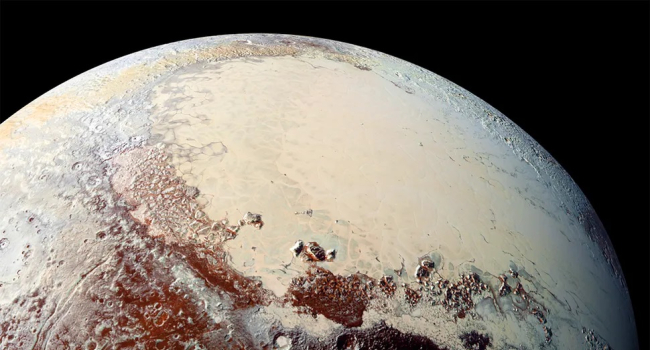
In 2015, NASA’s New Horizons probe flew past Pluto, revealing a surprising world of icy plains, mountains, and hints of a subsurface ocean. A decade later, scientists are still trying to solve the mysteries of this dwarf planet. A new mission, called Persephone and proposed by a team led by planetary scientist Carly Howett from the University of Oxford, could answer a key question: does liquid water exist beneath Pluto’s icy surface? However, the ambitious project faces significant challenges. Here’s what Persephone is and the secrets it may uncover.
The Mystery of the Subsurface Ocean
Before the New Horizons flyby in 2015, most scientists considered a liquid ocean on Pluto unlikely. Icy worlds like Pluto are expected to freeze solid over billions of years unless they have a heat source. However, images from New Horizons showed a young surface almost devoid of craters, suggesting recent geological activity and possibly the presence of liquid water.
- The Role of Charon: Pluto’s largest moon, Charon, is nearly equal to it in mass, forming a system similar to a double planet. Gravitational interactions between Pluto and Charon could maintain the heat needed to keep water liquid, especially if the ocean contains antifreeze-like substances.
- New Questions: The brief New Horizons encounter (just a few hours of close observation) left more questions than answers. Scientists want to know if an ocean exists today and how it influences Pluto’s surface.
The Persephone mission, named after the Greek mythological “Queen of the Underworld,” reflects both the mythological link to Pluto and the prominent role of women in leading the project.
What Persephone Will Study
The mission proposes a three-year stay in orbit around Pluto, enabling a detailed study of the dwarf planet and its moons. Equipped with 11 instruments based on proven spacecraft technology but with upgrades, Persephone will focus on:
- Searching for the Ocean: By analyzing Pluto’s shape to detect a “fossil bulge” — a swelling that may have formed when a liquid layer froze — the mission will provide more precise data on Pluto’s interior than New Horizons
- Surface Composition: Gravity and topography measurements, similar to those used for Saturn’s moon Enceladus, will help determine the makeup of Pluto and Charon, as well as the thickness of their ice shells.
- Atmosphere: New Horizons found Pluto’s thin atmosphere partially settling on Charon, creating a reddish pole. Persephone will directly analyze the atmosphere’s composition using mass spectrometry.
- Surface and Activity: High-resolution cameras will map all of Pluto’s surface, including the half hidden in darkness during New Horizons’ flyby. They will search for activity such as hot spots or eruptions and detect changes since 2015.
- Pluto’s Small Moons: Persephone will investigate Pluto’s four minor moons — Styx, Nix, Kerberos, and Hydra — analyzing their makeup (water ice and ammonia) and possible origin from an ancient collision.
The mission could also visit another Kuiper Belt object, similar to New Horizons’ extended mission to Arrokoth, if extended by a year. This would provide valuable insights into the early Solar System.
Mission Challenges
Persephone is highly ambitious and faces major obstacles:
- Duration: The journey would take 27.5 years due to planetary alignments, with the entire mission lasting over 50 years. This would require multiple generations of scientists, making knowledge transfer and planning difficult.
- Power Supply: Operating in deep space’s cold requires five radioisotope thermoelectric generators (RTGs) fueled by plutonium. NASA currently produces only 1.5 kg of plutonium per year, while one RTG requires 4.8 kg, creating a supply challenge.
- Cost: The estimated $3 billion price tag places it in the Flagship mission class, requiring large-scale funding.
- Launch Windows: Available launch opportunities are between 2029 and 2032; the next chance after that would come a decade later due to Jupiter’s orbit.
Despite these challenges, the success of long-term missions like Hubble (35 years) and Voyager (48 years) shows that such projects are possible. Persephone is designed with redundancy to ensure reliability.
Outlook and Significance
Persephone was developed as part of NASA’s Planetary Mission Concept Study program, which helps set priorities for future exploration. While high energy and budget requirements make a near-term launch unlikely, the project has demonstrated that a Pluto orbiter is technically feasible. Some mission design elements, such as the orbital tour plan, could be reused for other spacecraft.
Carly Howett emphasizes: “Persephone has shown that returning to Pluto is possible — but it’s expensive. This is a Flagship-level mission.” Advances in RTG technology and strong NASA support could improve its chances in the future.
In Short…
The Persephone mission promises to reveal Pluto’s secrets, including a possible subsurface ocean, atmospheric composition, and unique surface features. A three-year orbital mission with 11 instruments could deliver unprecedented data on the dwarf planet and its moons. However, the long travel time, plutonium requirements, and high cost make it a complex undertaking. Still, Persephone underscores that Pluto remains a mysterious world worthy of exploration and inspires scientists to dream of new expeditions to the far reaches of the Solar System.