make preferable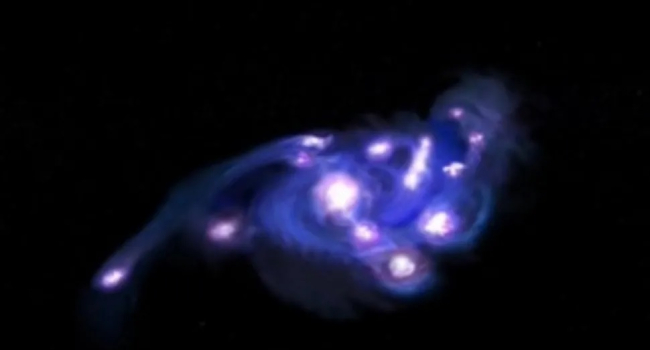
Astronomers have discovered an unusual galaxy, dubbed “Cosmic Grapes,” which formed just 930 million years after the Big Bang. This distant galaxy, captured using the James Webb Space Telescope (JWST) and the Atacama Large Millimeter/submillimeter Array (ALMA), contains at least 15 massive star-forming clusters resembling a bunch of grapes. The discovery, published on August 7, 2025, in Nature Astronomy, changes our understanding of how galaxies formed in the early Universe. Here’s why it matters and how scientists uncovered the secrets of “Cosmic Grapes.”
The Discovery of “Cosmic Grapes”
The galaxy, located at a distance corresponding to 930 million years after the Big Bang, was studied through a powerful combination of techniques:
- Gravitational lensing: Astronomers used the effect of gravitational lensing, in which a massive foreground galaxy, RXCJ0600-2007, acts as a natural magnifying glass, amplifying the light from the distant “Cosmic Grapes.” This allowed for an unprecedentedly sharp image.
- Instruments: Over 100 hours of observations with JWST and ALMA provided high-resolution data that revealed the galaxy’s internal structure. Previously, the Hubble Space Telescope showed it as a smooth, rotating disk, but the new data told a different story.
Lead author Seiji Fujimoto, who began the work at the University of Texas at Austin (UT Austin) and continues it at the University of Toronto, noted: “This is one of the most strongly lensed distant galaxies, giving us a unique opportunity to study it in incredible detail.”
An Unexpected Structure
Observations revealed that “Cosmic Grapes” consists of at least 15 compact star-forming clusters, resembling bright purple grapes. These clusters, rich in dense gas, are actively creating new stars. Unlike the smooth structure expected of early galaxies, “Cosmic Grapes” shows:
- Massive clusters: The galaxy’s starlight is dominated by several large, dense regions rather than an even spread of stars.
- Disk rotation: Despite its fragmented structure, the galaxy maintains a smooth rotation of gas, linking small-scale internal structures with large-scale motion for the first time.
Co-author Mike Boylan-Kolchin, a professor of astronomy at UT Austin, said: “This discovery shows that many early galaxies, which appeared smooth, may actually conceal similar star-forming clusters.”
Why It Matters for Science
The discovery of “Cosmic Grapes” reshapes our view of galaxy evolution:
- Early star formation: The presence of massive clusters just 930 million years after the Big Bang points to more complex star-formation processes than previously thought. This suggests that early galaxies were more irregular than assumed.
- Revised models: Hubble observations often depicted early galaxies as smooth disks, but new JWST and ALMA data force scientists to reconsider models, including the possibility of hidden structures in other galaxies.
- Cosmic evolution: Studying such objects helps us understand how galaxies like our Milky Way formed and evolved in the first billion years of the Universe.
In Brief…
The galaxy “Cosmic Grapes,” revealed through gravitational lensing and the powerful capabilities of JWST and ALMA, offers a rare glimpse into the early Universe. Its unusual structure of 15 star-forming clusters, resembling grapes, and its rotating gas disk challenge previous ideas about galaxy formation. This August 7, 2025 discovery highlights the power of modern astronomical technology and promises fresh insights into how stars and galaxies emerged in the Universe’s first billion years.