make preferable
On July 26, 2025, residents of the southeastern United States witnessed a rare daytime fireball, bright enough to be captured by a satellite in orbit. This meteoroid, later named the McDonough meteorite, survived a blazing fall through the atmosphere and pierced the roof of a house in the city of McDonough, Georgia, leaving a dent in the floor just 4 meters away from an unsuspecting resident. Scientists from the University of Georgia (UGA) studied fragments of this cosmic visitor and concluded that it may be older than Earth itself. Here’s what is known about the McDonough meteorite, its origin, and its significance for science.
Fall of the McDonough Meteorite
On July 26, 2025, a bright fireball lit up the skies over the southeastern United States, astonishing residents with its brilliance in broad daylight. The meteoroid entered the atmosphere, partially burned up, but a fragment weighing about 50 grams pierced the roof of a house in Henry County, Georgia. It passed through the roofing, ventilation system, and ceiling, leaving a dent in the floor and breaking into tiny dust-like particles. According to researcher Scott Harris from UGA, the homeowner likely heard three simultaneous sounds: the impact with the roof, a miniature sonic boom, and the thud against the floor — comparable to the sound of a gunshot nearby.
Out of the 50 grams of the meteorite, UGA scientists received 23 grams for analysis. This meteorite became the 27th ever found in Georgia, and only the sixth whose fall was observed by witnesses.
Origin and Age
Analysis using optical and electron microscopy revealed that the McDonough meteorite belongs to the class of ordinary chondrites with low metal content (L). This is one of the oldest types of cosmic rock, formed about 4.56 billion years ago in the presence of oxygen — making it slightly older than Earth, whose age is estimated at 4.54 billion years.
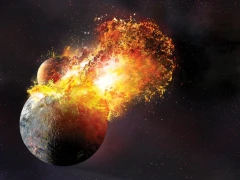
- Origin: Harris believes the meteorite came from the main asteroid belt between Mars and Jupiter. It likely formed after the destruction of a large asteroid about 470 million years ago, an event that ejected fragments — including the McDonough — into Earth-crossing orbits.
- Cosmic Journey: After the asteroid’s breakup, the meteoroid drifted through space for millions of years until its orbit intersected with Earth’s, leading to the dramatic fall in McDonough.
These chondrites are “cosmic time capsules,” preserving the chemical composition of the early Solar System, making them invaluable for studying planetary formation processes.
Scientific Significance
The McDonough meteorite offers scientists a rare opportunity to:
- Study the early Solar System: Chondrites contain chondrules — tiny spherical particles formed in the conditions of early space. Analyzing them helps scientists understand how planets and asteroids originated.
- Model asteroid orbits: Data on the meteorite’s trajectory refines understanding of how fragments from the asteroid belt reach Earth, which is crucial for assessing threats from larger objects.
- Evaluate risks: Understanding the composition and fall dynamics of meteorites like McDonough aids in developing strategies for defending against potentially hazardous asteroids.
Scott Harris plans to publish a paper detailing the meteorite’s composition and its atmospheric entry dynamics by the end of 2025. UGA is collaborating with Arizona State University to present the findings and officially submit the name “McDonough Meteorite” to the Meteorite Society’s Nomenclature Committee for inclusion in the Meteorite Bulletin.
Exhibition and Future
Fragments of the McDonough meteorite will be displayed at the Tellus Science Museum in Cartersville, Georgia. Visitors will be able to see its fusion crust — the dark, glassy surface formed during its heating in the atmosphere — and learn about its 4.56-billion-year journey. The exhibit will highlight the meteorite’s importance as a rare witness to the early history of the Solar System.
In Brief
The McDonough meteorite, which pierced a Georgia home’s roof on July 26, 2025, is older than Earth, having formed 4.56 billion years ago in the asteroid belt. Analysis by University of Georgia scientists reveals clues to the early Solar System and confirms its link to the destruction of a large asteroid 470 million years ago. This small piece of space, the 27th meteorite in Georgia’s history, not only has a remarkable story but also helps science better understand planetary formation and cosmic hazards. Soon, its fragments will become part of the Tellus Museum’s exhibition.