make preferable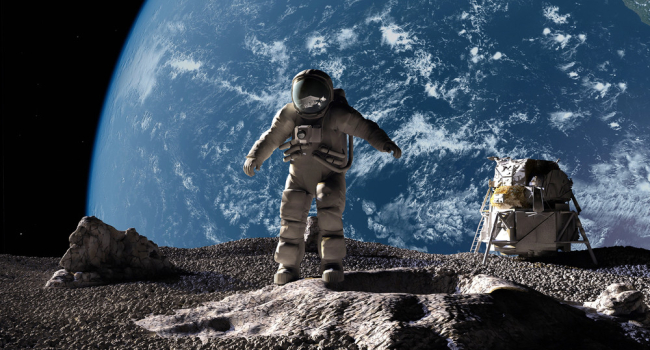
After decades of relative calm, the Moon is once again becoming a target of strategic interest for the world’s powers. Space is gradually losing its aura of pure scientific curiosity — the romance of exploration is giving way to the pragmatism of influence, technology, and resource control. Today, political competition over the Moon is becoming increasingly visible, and the return to it is no longer just a matter of science or prestige, but part of a broader international agenda.
The United States Prepares to Return to the Moon
Amid growing competition between major powers, the attention of the world’s space agencies is increasingly drawn to the lunar surface. NASA Administrator Sean Duffy stated in an interview that U.S. astronauts should land on the Moon within the next three and a half years — roughly by the end of 2028. In 2026, a crewed mission to lunar orbit is planned, without landing on the surface. The landing is expected to occur during the next U.S. presidential term, that is, before January 2029.
The Artemis program, under which preparations for humanity’s return to the Moon are underway, provides for a series of missions. Artemis III is the first crewed flight with a lunar landing, currently planned no earlier than mid-2027, though delays are possible due to technical problems, such as with the spacecraft’s thermal insulation. The mission envisions landing two astronauts at the Moon’s south pole, where they will remain for a week conducting scientific expeditions.
America Wants the “Best” Part of the Moon: The New Race Has Already Begun
Duffy previously announced Washington’s intention to install a 100-kilowatt nuclear reactor on the Moon’s surface by 2030. According to him, this is not just a technological challenge — it is a matter of strategic superiority in space.
“We are in a race with China for the Moon. And to build a base, we need power,” Duffy said on August 5 during a briefing organized by the U.S. Department of Transportation. He emphasized that the ultimate goal of the project is sustainable human presence on the Moon.
The location of the future lunar base, he said, is no accident:
“There’s a certain part of the Moon that everyone considers the best. There’s ice there. There’s sunlight there. We want to be the first to get there and stake a claim for America.”
Solar Power Is Not Enough — A Nuclear Reactor Is Needed
A lunar night lasts two Earth weeks, and solar panels cannot provide stable power for a lunar base — especially if it is located in the southern polar region, near craters that may contain water ice but never receive sunlight. In such conditions, nuclear power becomes the key to lunar exploration.
The new reactor will produce about as much energy as the average American household consumes in 3.5 days — enough to power scientific equipment, communications, and life support systems. Duffy noted that launching the reactor poses no risk:
“We’re not launching it in an active state,” he said, clearly anticipating possible public concerns.
A Flight Fifty Years in the Making
The planned mission will be the first since Apollo 17. In December 1972, the Apollo 17 crew left the Moon’s surface — the sixth and final crewed U.S. lunar mission. After that, the program was shut down. The reasons were pragmatic: financial costs, political priorities, and the exhaustion of initial goals. The lunar race was part of the Cold War, and once the U.S. had demonstrated technological superiority, the incentive to continue “proving” it sharply declined. The expeditions had cost the U.S. budget billions of dollars, while public pressure demanded that money be spent on domestic issues.
After Apollo 17, there was a long hiatus. Missions focused on low Earth orbit — building and servicing the ISS, launching satellites, and developing the Space Shuttle program. Lunar flights began to seem like a thing of the past — too expensive, too complex, and offering no immediate practical return.
The technology used in Apollo had become obsolete. And new solutions, especially in the areas of return capability and life support, were lacking. This created a paradox: humanity had reached the Moon in 1969, but by the 2020s it had found itself almost back at the starting line.
Conspiracy Theories: “Were They Really There?”
The long delay in new crewed lunar missions, the technical limitations of the 1960s, and the political atmosphere of the Cold War gave rise to numerous conspiracy theories about the Apollo program. The most popular one claims that there was no lunar landing at all — that the whole mission was staged, perhaps in a Hollywood studio.
Skeptics pointed to the absence of stars in photographs, strange shadows, a flag seemingly waving in the vacuum, and questioned the possibility of surviving the Van Allen radiation belts or trusting the reliability of 1960s technology.
NASA provided detailed technical responses to all such doubts. For example, the absence of stars was due to the cameras’ exposure settings; the flag “waved” due to inertia when it was planted; and astronauts passed through the radiation belts quickly and with adequate shielding. Evidence of the missions’ authenticity includes over 380 kg of lunar rock studied in international laboratories, telemetry data, orbital images showing the landing modules’ remains, and acknowledgment of the missions’ reality by the USSR, the U.S.’s main Cold War rival. Despite all this, the “Moon hoax” continues to live on the internet, fueled by public distrust of governments and a thirst for sensationalism.
The “Best” Part of the Moon in Alien Hands?
In recent years, Moon-related conspiracy theories have found a “second life” — no longer about denying the landings, but about “what they’re not telling us.” At the center are claims of UFOs and alien structures on the Moon, allegedly discovered during Apollo missions but hidden from the public.
Proponents of these theories claim astronauts might have encountered something inexplicable on the lunar surface — unknown signals, “anomalous objects,” traces of extraterrestrial civilization, or even operational alien bases. One piece of “evidence” often cited is supposed snippets of radio chatter cut from official records, in which astronauts speak of “observers” on the crater’s edge or “giant objects.” Such claims have been repeated in interviews by ufologists and conspiracy theorists — but none have been confirmed by reliable sources.
With modern technology — including private satellites, detailed orbital imagery, and advanced telescopes — not a single such claim has received visual confirmation. Nevertheless, in popular culture, the “Moon’s secrets” remain alive — in films, video games, and social media, where videos featuring “zoomed-in lunar craters” or “NASA exposés” gain millions of views.
Humanity Prepares to Take a New Step
Thus, despite decades of dormancy and the persistence of various conspiracy theories even today, humanity is preparing to take a new step — this time with more ambitious goals and advanced technology. In this context, upcoming missions will serve not only as a test of scientific progress but also as a critical element of international competition, with the Moon once again becoming an arena not only for research but for demonstrating the strength and ambitions of nations.