make preferable
Chinese astronomers have uncovered the nature of mysterious radio signals coming from deep space. These signals, known as ultra-long-period radio transients (ULPT), may originate from unusual stars — strange dwarf pulsars. The study, led by Professor Zhou Xia from the Xinjiang Astronomical Observatory, was published in The Astrophysical Journal.
The ULPT Mystery
Ordinary pulsars are rapidly rotating neutron stars that emit radio signals with high regularity, from milliseconds to seconds. However, ULPTs behave differently: their "bursts" occur at intervals of tens of minutes, which contradicts known physical laws. Such objects should not emit in the radio range with such slow rotation, yet they do, leaving scientists puzzled.
Examples of such objects include GLEAM-X J1627-52 and ASKAP J1832-0911, which attracted astronomers’ attention with their unusual periodicity and brightness.
The Strange Pulsar Hypothesis
Professor Zhou Xia’s team proposed an explanation: the source of ULPTs may not be ordinary neutron stars, but exotic objects containing strange quark matter in their core. This hypothetical form of matter arises under extremely high pressures, such as in the depths of superdense stars. Strange matter makes the star larger and allows it to generate radio signals even with slow rotation.
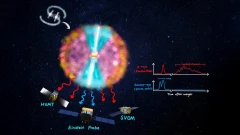
The model developed by the scientists successfully describes the characteristics of known ULPTs. For instance, ASKAP J1832-0911 shows synchronous changes in both radio and X-ray emissions, which aligns with predictions of the strange pulsar theory. Calculated values for magnetic field strength and brightness also match.
Significance of the Discovery
The discovery of strange dwarf pulsars could revolutionize our understanding of the physics of superdense objects. If the hypothesis is confirmed, it will be the first proof of the existence of strange quark matter in nature. These stars differ from classical neutron stars not only in composition but also in behavior, making them unique objects for studying extreme states of matter.
Future Research
To test the hypothesis, scientists plan to use next-generation telescopes such as FAST (China) and SKA (international project). These instruments have high sensitivity and will allow the discovery of more ULPTs and a detailed study of their properties. Observations will help confirm the presence of strange quark matter and reveal the internal structure of these mysterious stars.
Conclusion
Chinese astronomers have proposed a convincing explanation for the mysterious ULPT radio signals by linking them to a new type of star — strange dwarf pulsars. These objects may contain strange quark matter, making them unique in cosmology. Confirming the hypothesis using the FAST and SKA telescopes could mark a breakthrough in the study of superdense star physics and open a new chapter in understanding the structure of the universe.