make preferable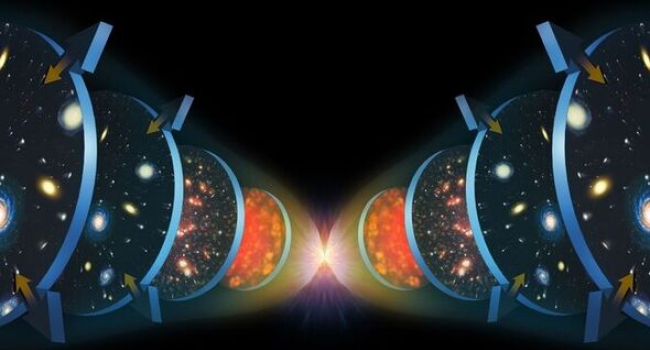
American physicist Stefano Profumo from the University of California, Santa Cruz, has proposed two groundbreaking hypotheses that may explain the nature of dark matter — the mysterious substance making up as much as 80% of the Universe’s mass. His work, published in the journal Physical Review D, explores the possibility of a "dark" copy of our Universe or the spontaneous emergence of dark matter during cosmic expansion.
Hypothesis 1: A “Dark” Copy of the Universe
The first theory suggests the existence of a hidden sector — a parallel Universe governed by physical laws similar to ours but composed of different particles and forces. In this "dark" version, there could be counterparts to quarks and gluons, forming heavy dark baryons. In the early Universe, these particles might have collapsed into superdense objects resembling microscopic black holes. Such objects would interact with ordinary matter only via gravity, making them invisible to current instruments. This theory offers a possible explanation for why dark matter remains elusive despite playing a vital role in galaxy formation.
Hypothesis 2: Dark Matter from Expanding Space
Profumo’s second idea links the origin of dark matter to the expansion of the Universe itself. He proposes that dark matter particles may have emerged spontaneously, similar to Hawking radiation generated at black hole event horizons. In this view, the expanding fabric of space could have produced stable particles without requiring complex interactions with other forms of matter. This model does not rely on exotic physical mechanisms and provides a simpler explanation for the emergence of dark matter.
Significance of the New Theories
“Both ideas allow us to reframe the question of dark matter’s nature without relying on standard models that have yet to be confirmed experimentally,” Profumo noted. Traditional models, such as the WIMP (Weakly Interacting Massive Particles) hypothesis, have not produced direct evidence despite decades of research. Profumo’s hypotheses open new paths for investigation, which could be explored through indirect observations — such as gravitational effects or anomalies in the cosmic microwave background.
Why Is Dark Matter Important?
Dark matter accounts for about 27% of the Universe’s mass-energy content and significantly influences galaxy formation and motion. It neither emits nor absorbs light, making it extremely difficult to detect. Scientists infer its presence solely through gravitational effects — for instance, its role in holding galaxies together or bending the light of distant stars. Profumo’s new ideas may guide future research toward more precise detection methods, including the analysis of cosmological data or the development of new experimental approaches.
Conclusion
Stefano Profumo’s theories present a fresh perspective on dark matter’s origins, proposing both a parallel “dark” Universe and the spontaneous generation of particles through cosmic expansion. Though not yet experimentally confirmed, these hypotheses push the boundaries of our understanding and encourage the scientific community to explore new methods of unraveling the Universe’s deepest mysteries. In the future, researchers hope to test these ideas through observations of gravitational waves, cosmic radiation, and other astrophysical phenomena.