make preferable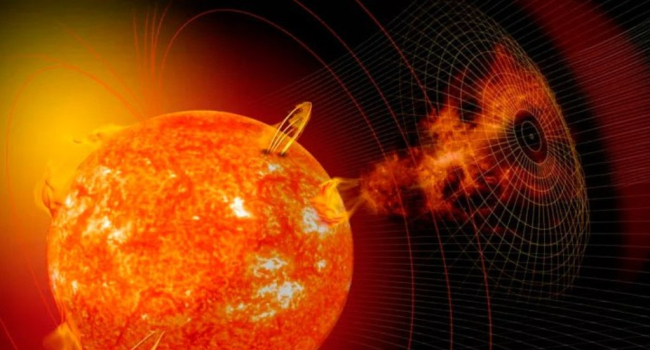
A solar flare of class M4.4 has been recorded on the Sun, becoming the most powerful one so far in August. The event was reported by the Solar Astronomy Laboratory of the Space Research Institute (IKI) of the Russian Academy of Sciences (RAS). The flare occurred in active region AR4168 and lasted from 18:46 to 18:58 Moscow time on August 5, surpassing previous solar events of the month in intensity.
Details of the M4.4 Flare
- Classification:4 — a mid-strength flare within the M-class range (M-class flares are moderate, 10 times weaker than X-class, but still capable of causing localized effects).
- Time: Started at 18:46 MSK, peaked at 18:58 MSK on August 6, 2025.
- Active Region: AR4168 — the same region responsible for earlier August flares.
- Impact:
- Caused a short-term R1-level (minor) radio blackout over the Atlantic Ocean.
- The associated coronal mass ejection (CME) is not Earth-directed, lowering the chances of major geomagnetic storms. However, weak G1-class storms are possible on August 7–8, which may enhance auroras.
Solar Activity Context — August 2025
August has shown heightened solar activity, as part of Solar Cycle 25, which is expected to peak around July 2025 (±8 months). Key events include:
- August 3:9-class flare at 06:00 MSK (AR4168), the strongest since June 20 (X1.9).
- August 4: Two flares — M1.4 and M2.0 — also from AR4168.
- August 1: Over 10 flares, mainly from AR4167, with scattered activity across the solar disk.
- August 5:4 flare — the fifth recorded in August and the strongest so far.
Comparison with Earlier Events
- The M4.4 flare surpassed August’s previous strongest (M2.9) but remains weaker than 2025’s most powerful events:
- May 14:7 (AR3664) — strongest of Cycle 25.
- February 23:3 (AR3590).
- June 20:9 (AR4114).
- A total of 9 X-class flares have been recorded in 2025, indicating an activity level above prior forecasts.
Consequences and Forecast
- Radio Disruptions: M-class flares, including M4.4, cause short-term disruptions in high-frequency radio communication (3–30 MHz) on Earth’s sunlit side. M4.4 led to a localized blackout over the Atlantic.
- Geomagnetic Storms: Although the CME from the M4.4 flare isn’t Earth-directed, AR4168’s position near the Earth-Sun line increases the chance of interaction. CMEs from August 3–4 could trigger weak G1-class geomagnetic storms on August 7–8, possibly enhancing auroras.
- Technology Risks: M-class flares pose little threat to power grids or satellites but can impact aviation and maritime navigation and communication.
- Future Activity: AR4168 remains under close watch due to its complex magnetic structure, which could produce further flares. NOAA forecasts a 65% chance of M-class and 30% chance of X-class flares in the coming days.
Solar Cycle 25 in Context
- Status: The Sun is in its solar maximum phase, which began in 2024 and is expected to continue through mid-2025. Activity is exceeding 2019 predictions, which anticipated a weaker cycle.
- Historical Perspective: 2024 saw a record number of X-class flares (over 50) — more than any year in the past 30 years. The August events confirm sustained high activity.
- Monitoring: Observations are conducted by IKI RAS, NASA (Solar Dynamics Observatory), and NOAA (Space Weather Prediction Center) using GOES satellites and coronagraphs.
Conclusion
The M4.4 flare of August 6, 2025, originating from AR4168, has become the most powerful in August, outpacing earlier events such as M2.9, M1.4, and M2.0. While it caused minor radio interference, no serious consequences for Earth are expected. The active region AR4168 remains a significant source of solar activity, and scientists continue monitoring for potential future flares. For risk mitigation, staying updated via NOAA and IKI RAS forecasts is advised — especially as Solar Cycle 25 reaches its peak.