make preferable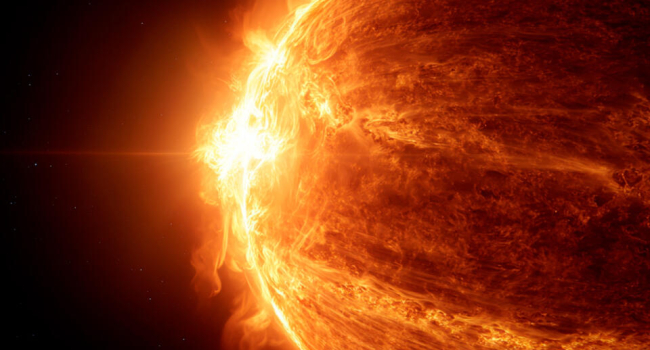
The Solar Astronomy Laboratory of the Space Research Institute (IKI) of the Russian Academy of Sciences (RAS) has reported a new powerful M-class solar flare that occurred on August 5, 2025. This marks the fourth such event this month, indicating a rise in solar activity as part of Solar Cycle 25. The announcement was made via the laboratory’s official Telegram channel.
Details of the Flare
The M-class flare occurred in the Sun’s active region AR4168. This event continued a series of flares that began in early August:
• August 3: M2.9-class flare — the most powerful in the last month and a half, also in AR4168. It caused a short-lived R1-level radio blackout over the Atlantic Ocean.
• August 4: Two flares, classified M1.4 and M2.0, also from AR4168.
• August 5: A new M-class flare (exact magnitude not specified in the RAS data).
Additionally, over 10 flares were recorded on August 1, mostly in active region AR4167, where accumulated magnetic energy was being released. The rest of the flares were evenly distributed across the solar disk.
What Are M-Class Solar Flares?
Solar flares are powerful bursts of electromagnetic radiation caused by the release of magnetic energy in active solar regions such as sunspots. They are classified by intensity:
• A, B, C: weak flares with minimal impact.
• M: moderate flares, capable of causing R1–R2 radio blackouts on Earth’s sunlit side and minor geomagnetic disturbances.
• X: the most powerful flares, which can lead to significant disruptions in radio communications, navigation systems, power grids, and strong geomagnetic storms.
The number following the letter (e.g., M2.9) indicates the intensity within the class, where M9 is nine times more powerful than M1. The M-class flares recorded in August are moderate, but their frequency signals an uptick in solar activity after a relatively quiet period.
Impact on Earth
According to RAS data, the August 3 flare in region AR4168 was accompanied by a coronal mass ejection (CME) that could have slightly affected Earth between August 5–6, causing a G1-level (minor) geomagnetic storm and increasing the chance of visible auroras. However, there is no direct evidence that the ejections from the August 4 and 5 flares were Earth-directed. Nonetheless, region AR4168 is located near the Sun–Earth line, increasing the potential for impact in future events.
M-class flares such as these can lead to:
• Radio blackouts: Temporary disruptions of high-frequency (3–30 MHz) radio communication, especially on the Earth’s dayside. For example, the M2.9 flare on August 3 caused a radio blackout over the Atlantic.
• Geomagnetic storms: If a CME reaches Earth, it can interact with the magnetosphere, triggering weak storms (G1–G2) that enhance auroras.
• Technology risks: While M-class flares rarely cause severe consequences, they can interfere with satellite navigation and radio signals used in aviation and maritime sectors.
Solar Activity Context
Solar Cycle 25, which began in December 2019, has turned out to be more active than scientists originally predicted. Initial forecasts expected a weak cycle, but since 2020, solar activity has exceeded expectations. The peak of the cycle (solar maximum) is expected in July 2025 (±8 months), and the August flares confirm the ongoing rise in activity as this peak approaches.
Earlier in 2025, stronger events were recorded:
• May 14, 2025: X8.7 flare from region AR3664 — the most powerful of the current cycle.
• February 2025: X6.3 flare from region AR3590.
• January–May 2025: Several X-class flares, including X5.8 (May 10) and X1.2 (May 13).
While the August M-class flares are less intense, they indicate continued activity in region AR4168, which remains under scientific observation.
Summary
The fourth M-class flare recorded on August 5, 2025, underscores the growing solar activity in Solar Cycle 25. All of August’s events are linked to active region AR4168, which may continue producing flares in the coming days. While the current flares do not pose a serious threat to Earth, their potential impact on radio communication and geomagnetic conditions requires ongoing monitoring. Scientists from RAS and international agencies such as NASA and NOAA continue to track solar activity to provide timely warnings about possible effects.
For up-to-date space weather information, visit the NOAA Space Weather Prediction Center at https://spaceweather.gov/.