make preferable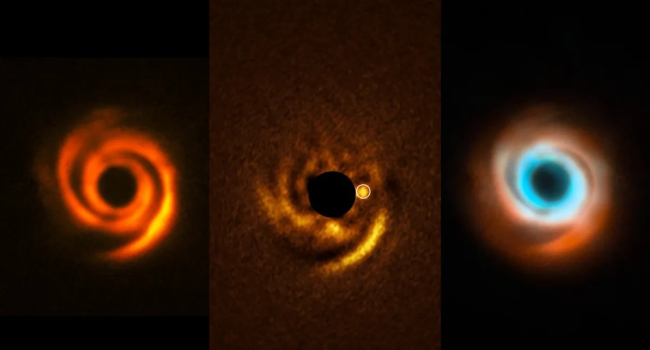
Astronomers have made a groundbreaking discovery by detecting complex organic molecules (COMs) — potential precursors to the building blocks of life — in the protoplanetary disk surrounding the young star V883 Orionis, located 1,305 light-years away in the Orion constellation. These molecules, identified using the Atacama Large Millimeter/submillimeter Array (ALMA) in Chile, include the first preliminary detections of ethylene glycol and glycolonitrile — compounds linked to amino acids and nucleobases like adenine, which is part of DNA and RNA. This finding, published in The Astrophysical Journal Letters, suggests that the chemical foundations of life form in space and may be widespread, delivered to young planets during their early stages of formation.
V883 Orionis: A Star in Formation
As reported by Space.com, V883 Orionis is a protostar approximately 500,000 years old — a mere infant compared to our 4.6-billion-year-old Sun. The star is in an active phase of mass accumulation, drawing in gas and dust from its surrounding disk, which will eventually form planets. This process is accompanied by powerful radiation outbursts that heat the disk, vaporizing frozen molecules and making them detectable by ALMA’s radio telescopes.
These bursts are powerful enough to warm even the normally cold regions of the disk, releasing the chemicals we detected, explains lead researcher Abubakr Fadely of the Max Planck Institute for Astronomy (MPIA). ALMA, a 66-antenna array in the Atacama Desert, enabled scientists to isolate the faint spectral signals of 17 complex organic molecules, including ethylene glycol and glycolonitrile, within the 348–366 GHz frequency range.
Complex Organic Molecules: The Building Blocks of Life
Complex organic molecules (COMs) are compounds containing more than five atoms, including at least one carbon atom. They are considered key precursors to biological molecules such as amino acids, sugars, and nucleotides — the fundamental components of DNA and RNA. In V883 Orionis’s protoplanetary disk, 17 such molecules were identified, including ethylene glycol (a sugar alcohol related to simple sugars like glycolaldehyde) and glycolonitrile (a precursor to the amino acids glycine and alanine, as well as adenine).
Glycolonitrile is particularly significant because it can react with ammonia to form glycine — the simplest amino acid — and also plays a role in the formation of adenine, one of the four DNA nucleobases. Ethylene glycol can be converted into glycolaldehyde — a simple sugar previously found in other stellar systems. These findings confirm that the chemical complexity necessary for life can develop even before planets exist.
Debunking the “Chemical Reset” Hypothesis
It was previously believed that the transition from protostar to young star with a protoplanetary disk involved destructive processes — intense radiation, shock waves, and gas ejections — that destroyed complex molecules formed in earlier stages. This led to the “chemical reset” hypothesis, suggesting that life-building molecules would have to reform within the protoplanetary disks during the formation of planets, asteroids, and comets.
However, the new data refutes this idea. Results show that protoplanetary disks inherit complex molecules from earlier stages, and their formation can continue during the disk phase, notes co-author Kimber Schwarz from MPIA. This suggests that life’s chemical precursors may be widespread throughout the universe, rather than limited to specific planetary systems.
How Were the Molecules Detected?
The discovery was made possible by the unique characteristics of V883 Orionis, which belongs to the FU Orionis class — objects undergoing dramatic brightness outbursts. These flares heat the surrounding disk, vaporizing ice-locked complex molecules and turning them into gases that emit radio signals detectable by ALMA. Researchers used spectroscopy to analyze 15 emission lines of ethylene glycol (at around 300°C) and 6 lines of glycolonitrile (at 88°C), confirming their presence using Monte Carlo modeling.
Ethylene glycol and glycolonitrile emit at radio frequencies, and ALMA is perfectly suited to detect them, explains Schwarz. However, the team notes that higher-resolution data is still needed to confirm these findings and potentially identify even more complex molecules.
The Cosmic Origin of Life
The detection of complex organic molecules in V883 Orionis supports the idea that life’s chemical foundations form in interstellar clouds and are inherited by protoplanetary disks. Simple organics such as methanol have been previously found in stellar nurseries, but the presence of more complex compounds like ethylene glycol points to ongoing chemical evolution.
A similar process occurs in our Solar System: as comets approach the Sun, they heat up, releasing molecules from their icy cores, forming their comas and tails. Ethylene glycol, for instance, has been detected in comets Lemmon and Lovejoy — highlighting a connection between distant star systems and our own.
The findings point to a continuous chain of chemical enrichment from interstellar clouds to fully formed planetary systems, says Fadely. This implies that the ingredients for life may be a standard part of planet formation, rather than a unique feature of Earth.
What’s Next?
Although the results are promising, scientists emphasize that not all spectral signals have been decoded. Higher-resolution data will confirm the detections of ethylene glycol and glycolonitrile and may reveal even more complex chemicals that we haven’t yet identified, notes Schwarz. Fadely adds that exploring other ranges of the electromagnetic spectrum may uncover further molecules: Who knows what else we might find?
This discovery not only deepens our understanding of life’s origins but also highlights that the chemical precursors to life may be pervasive across the universe. Future research with ALMA and other telescopes may reveal even more about how molecules like those in DNA and RNA form and spread throughout space.