make preferable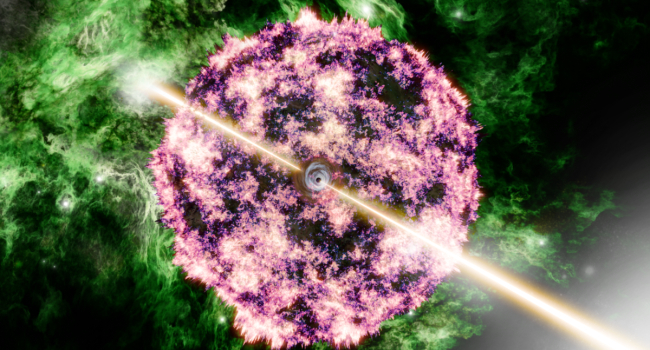
Astronomers have studied the most powerful explosion ever observed—dubbed the "Brightest Of All Time" (BOAT), or GRB 221009A—to unravel the mysteries behind gamma-ray bursts (GRBs), highly energetic phenomena that remain one of space’s most intriguing enigmas. This event, potentially the most intense since the Big Bang, has provided crucial new insights into the nature of these cosmic occurrences.
What Are Gamma-Ray Bursts?
Gamma-ray bursts are brief flashes of extremely high-energy radiation, surpassing in power everything the Sun will emit over its 10-billion-year lifetime. They typically last from milliseconds to a few minutes, followed by a fading afterglow that can be observed for hours or even months. GRBs originate from beyond the Milky Way, and their immense distances weaken their signals, making it difficult to pinpoint their sources.
There are two types of GRBs:
- Long-duration bursts (lasting more than 2 seconds): Usually associated with supernovae—the explosive deaths of massive stars that leave behind black holes.
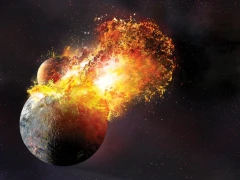
- Short-duration bursts (under 2 seconds): Occur when neutron stars collide and merge.
BOAT, detected on October 9, 2022, falls into the long-duration category. It is believed to have resulted from the supernova of a massive star located 2.4 million light-years away, which left behind a stellar-mass black hole.
What Makes BOAT Unique?
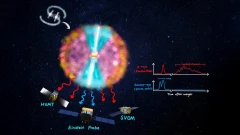
BOAT stands out from all other recorded gamma-ray bursts due to its extraordinary brightness. It was detected using several telescopes, including NASA’s Fermi and Swift space observatories. After the initial gamma-ray emission, an afterglow followed across multiple wavelengths, allowing ground-based telescopes to study it in detail. The unusually high intensity of the gamma radiation suggests that GRBs are more complex than previously thought, likely involving layered jets that accelerate particles to extreme energies.
Observations and Discoveries
BOAT was observed using the prototype Large-Sized Telescope (LST-1) at the Roque de los Muchachos Observatory in La Palma, Spain. Observations began 32 hours after the explosion under challenging full moon conditions and continued for 20 days. This allowed scientists to determine upper limits for high-energy gamma emissions and refine their understanding of how GRBs form.
LST-1 data revealed that the BOAT event was caused by a multi-layered plasma jet. Contrary to older models that pictured GRB jets as cylinder-shaped with a cap of low-energy particles, the new evidence points to a high-speed central cone surrounded by a slower outer sheath. This structure hints at a complex "central engine" driving the burst.
Why This Matters
Studying BOAT not only reveals details about gamma-ray bursts but also showcases the capabilities of modern telescopes like LST-1 for exploring the high-energy universe. Three more LSTs are being constructed at the same site in La Palma, with similar instruments being built in Chile. These observatories—spread across both hemispheres—will make it easier to detect GRBs quickly and study them with unprecedented precision.
In Conclusion…
Gamma-ray burst GRB 221009A, or BOAT, provided a rare opportunity to peer into the mechanics of the universe’s most powerful explosions. The study revealed that GRBs are complex phenomena involving layered plasma jets released during supernovae or neutron star mergers. As more advanced telescopes come online, scientists are poised to uncover even deeper truths about these cosmic events—bringing us closer to understanding the forces that shape our universe.