make preferable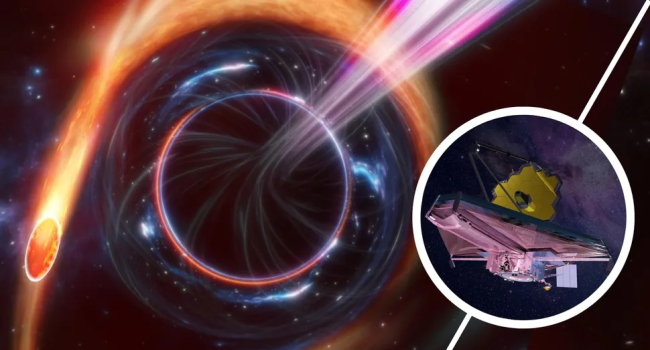
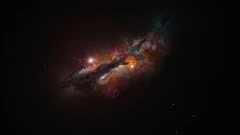
The James Webb Space Telescope (JWST) has, for the first time, captured tidal disruption events (TDEs)—moments when supermassive black holes tear apart and consume stars, releasing colossal energy. These observations, conducted in dusty galaxies, revealed that the black holes involved in these “stellar murders” had long been dormant, hidden behind dense clouds of gas and dust, until stars wandered into their gravitational traps.
What Are Tidal Disruption Events?
Tidal disruption events occur when a star ventures too close to a supermassive black hole, which can have a mass millions or even billions of times greater than the Sun. The black hole’s gravity exerts immense tidal forces, compressing the star horizontally and stretching it vertically, turning it into a thin “string”—a process scientists call “spaghettification.”
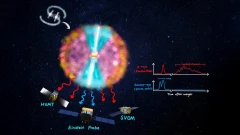
The disrupted star isn’t consumed instantly. Its matter forms an accretion disk—a rotating cloud of stellar debris that gradually feeds the black hole. These tidal forces cause the disk to emit intense radiation, and some of the star’s material is ejected in high-energy jets from the black hole’s poles. These jets emit electromagnetic radiation, making TDEs visible across the spectrum.
Since the 1990s, when the first TDE was detected with the ROSAT X-ray telescope, astronomers have recorded around 100 such events. However, most of these have been found in galaxies with little dust, where optical and X-ray emissions are easily observed. In dusty galaxies, where thick clouds absorb such emissions, detecting TDEs is much harder—this is where JWST, the most sensitive infrared telescope, comes in, able to peer through the dust.
The First TDEs Seen by JWST
A team led by Megan Masterson of the Massachusetts Institute of Technology used JWST to study four dusty galaxies suspected of harboring TDEs. The telescope detected infrared “fingerprints” of supermassive black holes consuming stellar material. A key indicator was the emission of neon, caused by the ionization of atoms by radiation from the accretion disk. This emission is unique and can only be produced by an actively feeding black hole.
Out of 12 galaxies studied, four exhibited this infrared signal—including the closest TDE to Earth, located in a galaxy 130 million light-years away. Observations showed that these black holes were in a “sleeping” state, not feeding on material until stars approached them.
Dormant Black Holes and Their Features
Unlike active galaxies, where black holes constantly feed on gas and dust and are surrounded by dense dusty “toruses,” the four galaxies in this study showed different structures. Their dust clouds lacked the typical formation seen in active galaxies, suggesting the black holes were inactive until the onset of the TDEs. This confirms that the observed flares in these galaxies could only have been caused by tidal disruption of stars.
“These observations show that these flares can only be TDEs,” said Masterson. She added that the process of consuming stellar material takes time, and studying these events will help determine how much matter black holes absorb, how much they eject, and how long a TDE lasts.
The Significance of the Discovery
JWST’s observations are reshaping our understanding of TDEs, revealing that these events might be common in dusty galaxies previously hidden from view. This discovery is important for several reasons:
- TDE Frequency: If TDEs are widespread in dusty galaxies, their total number in the universe may be much higher than previously believed.
- Black Hole Properties: Studying TDEs offers insights into the mass, spin, and accretion disk structure of supermassive black holes.
- New Technologies: JWST’s success highlights the power of infrared astronomy to uncover hidden cosmic phenomena.
Future Research
The team plans to continue searching for TDEs in dusty galaxies to better understand how they occur and how black holes interact with stars. Additional data will help determine how long TDEs last and how much material is consumed. Future observational capabilities will be enhanced by the construction of three new LST telescopes in Spain and similar instruments in Chile, allowing for faster detection and more detailed studies of such events.
In Conclusion...
The discovery of TDEs in dusty galaxies using the James Webb Space Telescope marks a breakthrough in the study of supermassive black holes and their interactions with stars. Observations showed that “dormant” black holes, hidden in dusty clouds, can suddenly “awaken,” tearing stars apart and producing bright flares. These findings not only shed light on the nature of TDEs and gamma-ray bursts but also demonstrate JWST’s potential for exploring previously inaccessible corners of the universe.