make preferable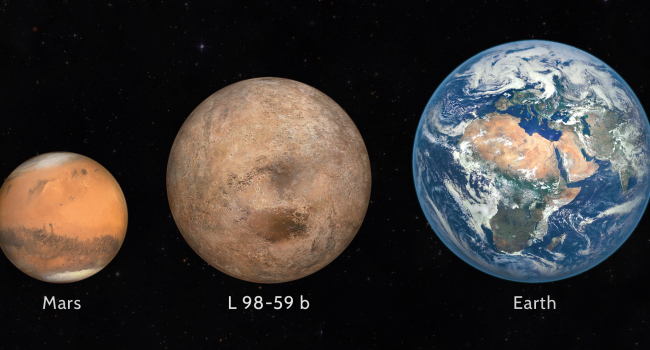
Astronomers have discovered a fifth exoplanet in the L 98-59 star system, located 35 light-years from Earth. The newly found planet, named L 98-59 f, lies within the star's habitable zone, where conditions could allow for the presence of liquid water — a key factor for potential life. The research, conducted by scientists at the Trottier Institute for Research on Exoplanets at the University of Montreal, was published on July 12 in the journal Earth and Planetary Astrophysics and reported by Space.com. This discovery highlights the uniqueness of the L 98-59 system and makes it a high-priority target for future exploration.
Discovery Details
L 98-59 is a cool red dwarf star surrounded by a compact system of small rocky planets. The new planet, L 98-59 f, is classified as a “super-Earth” with a minimum mass 2.8 times that of Earth. It follows a nearly circular orbit with a period of 23 Earth days and receives approximately the same amount of stellar energy as Earth does from the Sun. This places it in the star's habitable zone, where, under the right atmospheric conditions, liquid water could exist.
The discovery of L 98-59 f was made possible through data analysis from:
- HARPS (High Accuracy Radial velocity Planet Searcher) and ESPRESSO (Echelle Spectrograph for Rocky Exoplanet and Stable Spectroscopic Observations) from the European Southern Observatory (ESO), which detected slight stellar wobbles caused by the planet’s gravity.
- TESS (Transiting Exoplanet Survey Satellite) and NASA’s James Webb Space Telescope (JWST), which helped refine the planetary parameters.
Since L 98-59 f does not transit its host star, scientists used the radial velocity method to detect it, measuring the star’s "wobble" due to gravitational interactions. Advanced filtering techniques allowed researchers to accurately determine the sizes, masses, and characteristics of all five planets in the system.
The Uniqueness of the L 98-59 System
The L 98-59 system stands out for its compactness and diversity of planets:
- L 98-59 b: The innermost planet, about 84% the size of Earth and half its mass, is one of the smallest known exoplanets. Tidal forces may cause volcanic activity.
- L 98-59 c and d: The second planet has low density, suggesting a possible abundance of water, making it unique compared to planets in our Solar System.
- L 98-59 e and f: Located farther out, with L 98-59 f situated in the habitable zone, making it the main target in the search for signs of life.
“The discovery of a temperate planet in such a compact system is an exciting event,” said Charles Cadieux, lead author of the study. “It highlights the diversity of exoplanetary systems and strengthens interest in studying potentially habitable worlds around low-mass stars.”
Scientific Significance
The L 98-59 system offers a unique opportunity to study planetary system formation and evolution. Its proximity to Earth (35 light-years) and the small size of its star make its planets ideal for atmospheric analysis using JWST. If L 98-59 f has an atmosphere, the telescope may be able to detect water vapor, carbon dioxide, or even biosignatures — chemical indicators of life.
The diversity of planets — from volcanically active to potentially water-rich — allows researchers to compare composition and development, helping us understand how habitable worlds form and what conditions are necessary for life.
Prospects and Challenges
Future research on L 98-59 f will focus on analyzing its atmosphere, if present. JWST could use spectroscopy to detect its chemical makeup — a key step in the search for biosignatures. However, several challenges remain:
- Lack of transits: Without the planet crossing in front of its star, atmospheric analysis becomes more difficult and requires more advanced instruments.
- Red dwarf activity: Red dwarfs often have strong flares that may affect the habitability of their planets.
- Limited data: Current measurements only reveal the minimum mass of L 98-59 f, and the planet’s precise composition is still unknown.
NASA and ESO plan to continue observing the system to refine planetary parameters and prepare missions for detailed study.
Conclusion
The discovery of the “super-Earth” L 98-59 f in the habitable zone of the L 98-59 star marks a major milestone in astronomy, underscoring the potential of red dwarf stars in the search for habitable worlds. Located just 35 light-years from Earth, this planet may become a key target for the JWST in the hunt for water and biosignatures. The system’s diversity offers a rare opportunity to study planetary evolution, and the star’s proximity makes it ideal for future exploration. This discovery brings humanity one step closer to answering the question of whether life exists beyond our Solar System.