make preferable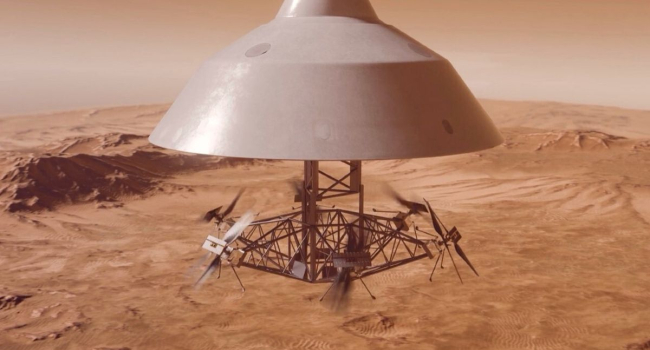
A new Mars exploration concept, dubbed “Skyfall,” promises a revolutionary approach to studying the Red Planet. Developed by AeroVironment in collaboration with NASA’s Jet Propulsion Laboratory (JPL), the project involves deploying six autonomous reconnaissance helicopters into the Martian atmosphere. Scheduled for launch in 2028, the mission aims to accelerate preparations for human landings on Mars by providing a cost-effective and efficient method for data collection. This was reported by Space.com.
Skyfall Mission Concept
The “Skyfall” project envisions deploying six compact helicopters that will be released from a capsule during atmospheric entry on Mars. This maneuver — called the “Skyfall Maneuver” — eliminates the need for a traditional landing platform, which is one of the most expensive and complex components of Mars missions. Removing the platform cuts costs and risks, making the mission more accessible.
Each helicopter will operate autonomously, performing the following tasks:
- Surface imaging: Transmitting high-resolution images to Earth, aiding in the selection of safe landing sites for future astronauts.
- Subsurface radar scanning: Gathering data on the soil composition, including water, ice, and other resources critical to human missions.
This information will enable NASA and other agencies to identify optimal resource-rich landing zones, a key step toward crewed Mars missions in the 2030s.
The Legacy of Ingenuity
The “Skyfall” mission builds on the success of the Mars helicopter Ingenuity, which completed 72 flights in Jezero Crater between 2021 and 2024. Ingenuity made history as the first powered aircraft to fly on another planet on April 19, 2021, proving that aviation is possible in Mars’ thin atmosphere.
Unlike Ingenuity, which was a single technology demonstrator, Skyfall will deploy six helicopters for large-scale reconnaissance. According to William Pomerantz, head of space programs at AeroVironment, “With six helicopters, Skyfall offers a cost-effective solution that greatly expands area coverage, data volume, and scientific research — bringing us closer to the first human steps on Mars.”
Technical and Economic Advantages
Key benefits of the Skyfall mission include:
- Cost savings: Eliminating the landing platform reduces mission costs, making it one of the most affordable Mars exploration efforts.
- Scalability: Six independent helicopters allow for simultaneous exploration of multiple priority zones selected by NASA and industry partners.
- Autonomy: The helicopters are equipped with navigation systems similar to those used in Ingenuity, enabling them to operate without real-time control from Earth — crucial due to the 5–20 minute signal delay.
AeroVironment has already begun internal investments and coordination with JPL to prepare for the 2028 launch, which aligns with a favorable window for Mars missions.
Prospects and Challenges
The Skyfall mission could become a vital step in preparing for NASA’s crewed Mars missions in the 2030s. The data collected by the helicopters will aid not only in landing site selection but also in studying Martian geology and searching for signs of ancient life.
However, the project faces several challenges:
- Technical complexity: Deploying six helicopters in the Martian atmosphere requires precise, highly reliable systems.
- Funding: Although positioned as a budget-friendly mission, it still depends on NASA’s approval and financial backing.
- Competition: Other initiatives, such as Mars sample return missions, may divert resources from Skyfall.
AeroVironment and JPL plan to leverage technologies from Ingenuity, including avionics and software, to speed up development and reduce risks.
Conclusion
The Skyfall mission represents a bold and innovative approach to Mars exploration, building on the legacy of Ingenuity. Six autonomous helicopters dropped from the air will cover vast areas, collect valuable data, and lay the groundwork for future human missions. With a planned launch in 2028, the project promises to be a cost-effective and efficient solution that brings humanity closer to its dream of landing on the Red Planet. If successful, Skyfall could not only transform Mars mission strategies but also inspire a new generation of space explorers.