make preferable
Neutrinos are among the most mysterious particles in the universe—barely interacting with matter, yet playing a crucial role in cosmic processes. A new study by American scientists, published in Physical Review Letters (PRL), suggests that during the collapse of massive stars, neutrinos may begin to collide with one another, creating conditions akin to a giant cosmic particle accelerator. This discovery could uncover hidden neutrino interactions beyond the current Standard Model of physics.
Neutrinos and Stellar Collapse
Neutrinos are known for their ghost-like ability to pass through matter undetected. However, they become central players in the final moments of a massive star's life, particularly those with masses significantly greater than the Sun's.
As the star’s core collapses, electrons reach near-light speeds, driving the system toward instability. In this extreme state of density and temperature, neutrinos—normally able to escape freely—become trapped inside the core. In this trapped environment, they start to collide with each other, essentially transforming the core into a natural neutrino collider.
"Secret" Neutrino Interactions
According to the Standard Model, neutrinos come in three types (or “flavors”): electron, muon, and tau neutrinos. During a typical stellar collapse, electron neutrinos dominate, helping to cool the star’s core, which often leads to the formation of a neutron star.
However, the new study suggests that neutrinos may engage in “secret” interactions not predicted by the Standard Model. These could cause flavor conversion, producing a more balanced mix of all neutrino types. In such a case, the core would remain hotter, and the collapse might instead result in the formation of a black hole, not a neutron star.
Why This Matters
Detecting neutrino collisions within collapsing stars offers a new pathway to study their fundamental properties. If the hypothesis of secret interactions is confirmed, it could revolutionize our understanding of particle physics. Such interactions may hint at new laws of nature that go beyond our current models.
Looking Ahead: Future Experiments
This hypothesis may soon be tested by experiments like the Deep Underground Neutrino Experiment (DUNE) in the U.S., expected to begin operations within the next few years. DUNE will be capable of analyzing neutrinos from astrophysical sources with high precision.
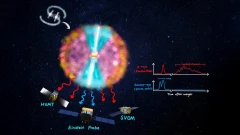
In addition, gravitational wave detectors and neutrino observatories—such as LIGO and IceCube—are already tracking signals from collapsing stars. These instruments could provide crucial data to support or refute the theory. Notably, in 2023, the James Webb Space Telescope detected neutrinos from a supernova in the galaxy Messier 82, marking a key step toward understanding these extreme phenomena.
Conclusion
This new research shows that massive stellar collapses may act as natural laboratories for probing neutrino behavior and uncovering potential hidden interactions. If confirmed, the findings could reshape both particle physics and our models of stellar evolution. As projects like DUNE come online and telescopes continue to observe the universe, we move closer to unraveling the secrets of these elusive particles—and with them, the fundamental laws that govern the cosmos.