make preferable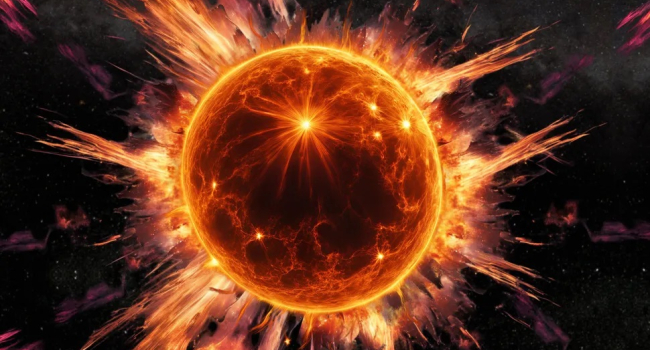
Extremely massive stars, those over 100 times the mass of the Sun, are the rock stars of the cosmos — brilliant, powerful, fast-living, and short-lived. A new study, published on the preprint server arXiv, reveals that such stars eject far more matter into space than previously believed before collapsing into black holes. Scientists from the Scuola Internazionale Superiore di Studi Avanzati (SISSA) in Italy, led by Kendall Shepard, have uncovered how powerful stellar winds shape the evolution of these giants and influence the formation of black holes. Here's why this discovery reshapes our understanding of the Universe.
Supermassive Stars: Life in Fast-Forward
Unlike our Sun, which will live around 10 billion years, supermassive stars burn through their nuclear fuel in just a few million or even hundreds of thousands of years. With masses between 100 and 230 times that of the Sun, they are rare but extremely influential cosmic objects. These stars not only shine intensely but also generate powerful stellar winds — streams of particles that tear away their outer layers and enrich surrounding space with elements like carbon and oxygen, essential for forming new stars and life.
"Very massive stars are like the rock stars of the Universe: powerful, short-lived, and explosive. Their stellar wind is more like a hurricane than a gentle breeze," explains Kendall Shepard in an interview with Space.com.
Such stars are also progenitors of black holes, including binary systems that, when merged, produce gravitational waves detectable on Earth. Shepard’s study shows that the stellar winds of these giants are much stronger than previously assumed, which changes how scientists view black hole formation.
New Observations and Modeling
Supermassive stars are rare and were difficult to study until recently due to limited observations. However, with the help of space- and ground-based telescopes, researchers were finally able to observe them directly in the Tarantula Nebula in the Large Magellanic Cloud. Among these stars is R136a1 — the most massive known star, weighing in at up to 230 solar masses and only 1.5 million years old (compared to the Sun’s 4.6 billion years).
Observations show that these stars belong to a rare class known as WNh stars — hot, luminous, and still retaining hydrogen at their surface. With surface temperatures reaching 40,000–50,000 °C, they defy standard stellar models, which predict cooling and expansion in late evolutionary stages. To explain this discrepancy, Shepard's team developed an updated stellar evolution model using the PARSEC code (PAdova and TRieste Stellar Evolution Code), incorporating much stronger stellar winds.
"Our new models, which include enhanced stellar winds, now match the observations. These powerful winds strip away the star’s outer layers, preventing cooling and maintaining the surface composition typical of WNh stars," Shepard explains. This allows the stars to remain hot and compact longer, aligning with what astronomers actually see.
How Do Giants Like R136a1 Form?
The study identifies two possible formation pathways for supermassive stars like R136a1:
- Single star origin: R136a1 may have formed with an initial mass exceeding 100 solar masses. This would require revising the theoretical upper limit for stellar mass in the local Universe.
- Merger of a binary system: Two stars in a binary system could have merged into one supermassive star. This scenario requires a lower initial mass, making it statistically more plausible.
"I was surprised that our results support two different explanations for the origin of R136a1. The idea that binary mergers could produce such giants is particularly exciting," notes Shepard.
Implications for Black Holes
Strong stellar winds significantly affect the mass of black holes formed after a star collapses. Because the winds strip away a large portion of the star’s mass, the resulting black holes are smaller than previously predicted. This reduces the likelihood of forming intermediate-mass black holes (100–10,000 solar masses), which astronomers still struggle to detect conclusively.
"Stronger winds lead to smaller black holes, making our models more consistent with real observations," Shepard explains. The updated models also better explain the existence of massive binary black holes, with components over 30 solar masses, which merge and produce gravitational waves recorded by detectors like LIGO and Virgo.
In traditional models with weaker stellar winds, stars in binary systems often expand and merge before collapsing. Stronger winds, however, help the stars stay separated, allowing them to evolve into a pair of black holes that can later spiral inward and merge.
What’s Next?
This research focused on stars in the Large Magellanic Cloud, which has a unique chemical composition. The next step is to apply these new models to other regions of the Universe with different metallicities. This will help astronomers understand how black hole populations vary across different environments.
"Our results are not yet universal. We aim to study stars with a range of chemical compositions to model different corners of the cosmos," Shepard concludes. "It will be exciting to see how predictions about black holes change."
Why This Matters
Supermassive stars play a crucial role in cosmic evolution:
- Their stellar winds and supernova explosions enrich the Universe with elements necessary for stars, planets, and potentially life.
- Carbon and oxygen released by such stars are fundamental building blocks of life.
- They give rise to black holes, including binary systems that merge and produce gravitational waves — a new way to observe and understand the Universe.
On social platform X, users are discussing the findings enthusiastically: "R136a1 is a true monster! 230 solar masses — and that's not even the limit?" writes one user. Others add, "These new stellar wind models could reshape our understanding of black holes and gravitational waves."
Conclusion
Supermassive stars like R136a1 eject tremendous amounts of material through powerful stellar winds before collapsing into black holes. The new study by Kendall Shepard's team, based on observations from the Tarantula Nebula and modeling with the PARSEC code, shows that these winds are much stronger than previously believed. This helps explain the properties of WNh stars, lowers the chances of forming intermediate-mass black holes, and supports the formation of massive binary black holes that generate detectable gravitational waves. The findings open new pathways for understanding stellar evolution and black hole formation, with more exciting discoveries expected as models expand to new cosmic environments.