make preferable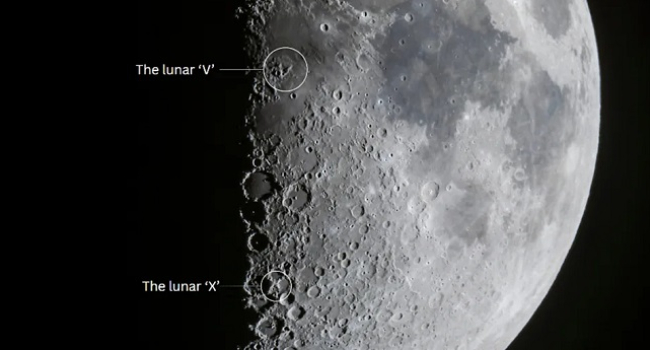
On July 2, 2025, during the first quarter of the Moon, remarkable formations resembling the letters “X” and “V” will appear on its surface. This optical phenomenon, known as the clair-obscur effect (from the French clair-obscur, meaning “light-dark”), is caused by the interplay of sunlight and shadows. Here’s how and when to observe these rare lunar “letters,” what equipment to use, and where to look.
What Are the Lunar “X” and “V”?
The clair-obscur effect occurs when sunlight strikes the Moon’s surface at just the right angle, illuminating crater edges and highlands to cast shadows that form recognizable shapes. During the first quarter, when half of the Moon is lit, these shadows highlight surface relief and bring the “X” and “V” into view. They’re not physical features, but optical illusions created by lighting conditions.
- Lunar “X”: Formed by the illuminated rims of the craters Blanchinus, La Caille, and Purbach (38 km, 68 km, and 118 km in diameter, respectively). It appears about 25° south of the lunar equator, near the craters Werner and Aliacensis, along the terminator—the line dividing the Moon’s light and dark sides.
- Lunar “V”: Created by sunlight hitting the walls of Ukert Crater (23 km) and nearby smaller craters. Located about 10° north of the lunar equator, also near the terminator.
These formations are visible for roughly 4 hours before the Moon reaches its exact first quarter phase and are most striking on the shadowed side of the terminator, where sunlight just grazes elevated terrain.
When and Where to Observe
- Date and Time: The first quarter Moon occurs at 11:41 PM EDT on July 2 (03:41 GMT on July 3). The “X” and “V” start becoming visible about four hours earlier.
- Viewing Tips:
- Find a location with a clear view of the horizon, away from trees, buildings, and light pollution.
- Allow your eyes 10–15 minutes to adjust to the dark.
- Clear skies are crucial—check forecasts on sites like Ventusky or your local weather service.
What Equipment to Use
- Binoculars: Binoculars with apertures between 50–70 mm (such as 10x50 or 15x70) work well. A tripod is recommended for stability. Models with ED (extra-low dispersion) lenses reduce distortion.
- Telescopes: A beginner telescope with a 6-inch (150 mm) aperture is sufficient. For more detail, consider an 8- to 10-inch telescope. Low magnification (50–100x) is ideal for seeing the overall shape—too much zoom highlights small features that can obscure the illusion.
- Astrophotography: Use a camera with good light sensitivity (e.g., Canon EOS or Sony Alpha) and lenses of 300 mm or more. A smartphone attached to a telescope also works. Suggested settings: ISO 100–400, exposure 1/100–1/250 sec, depending on brightness.
How to Find the “X” and “V”
- Lunar “X”:
- Locate the terminator line between the lit and dark halves.
- Look about one-third of the way up from the Moon’s south pole (~25° S).
- Search near the Werner and Aliacensis The “X” appears when sunlight hits the elevated edges of Purbach, La Caille, and Blanchinus, leaving their interiors in shadow.
- Lunar “V”:
- Move your view north along the terminator (~8° N).
- Find Ukert Crater, just south of Mare Vaporum (the Sea of Vapors). The “V” forms from the lit walls of Ukert and nearby ridges.
Pro Tip: Use lunar maps like Virtual Lunar Atlas or the SkySafari app to locate craters precisely. The “X” typically appears when the terminator’s selenographic colongitude is around 358°.
Additional Observing Tips
- Best Time: Begin watching around 7:00–8:00 PM local time on July 2 while the Moon is still high. In Moscow and western Russia, the Moon may set near midnight—don’t wait too long.
- Daytime Viewing: The “X” and “V” can be visible in daylight under clear skies. Never point optical equipment near the Sun without proper solar filters.
- Watch the Evolution: These formations are fleeting—“X” forms over 2.3 hours, shines brightly for about an hour, and fades after 70 minutes as shadows shift.
- Other Clair-Obscur Effects: Try spotting “Clavius Eyes” (during a waxing gibbous Moon) or the “Moon Maiden” near Sinus Iridum.
Why You Shouldn’t Miss It
The lunar “X” and “V” aren’t just beautiful—they offer a chance to experience the Moon the way Galileo did when he first aimed a telescope skyward. These clair-obscur effects reveal the rugged texture of the lunar surface and evoke a sense of cosmic wonder. While they appear a few times a year, this July’s event is especially well-timed for evening observers.
- Next Dates: If you miss the July 2 event, the next good opportunity is August 3, 2025. Check sites like Sky & Telescope for updated schedules.