make preferable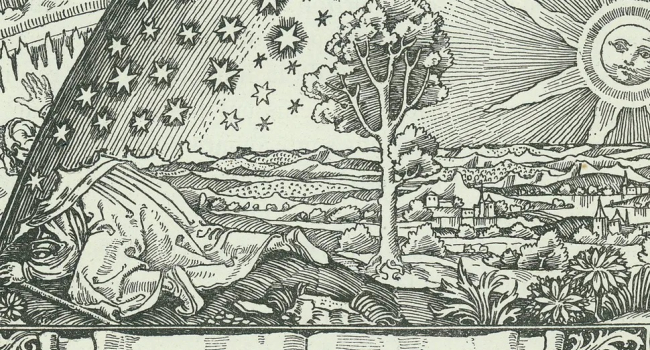
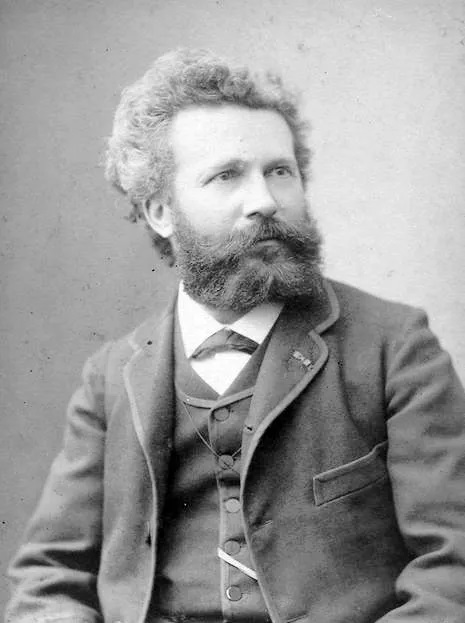
At a time when Mars was a distant and mysterious world, unreachable by telescopes or spacecraft, Parisian astronomer Camille Flammarion used the power of imagination to bring the Red Planet to life. In the late 19th century—long before rockets and rovers—he combined science and fiction to envision what life on Mars might be like. His works, including the scientific volume The Planet Mars (1892) and novels like Uranie (1889), not only popularized astronomy but also inspired generations of dreamers, including author H.G. Wells. Here’s how Flammarion reshaped our perception of Mars—and why his ideas remain relevant today.
Mars in the 19th Century: An Age of Mysteries
The second half of the 19th century was a turning point in the study of Mars. New, more powerful telescopes and improved printing technology enabled astronomers to produce detailed maps of the planet, filled with “continents,” “seas,” and even canals that some interpreted as signs of intelligent life. However, due to limited image clarity, these maps varied widely, often reflecting the astronomers’ imagination more than reality.
Camille Flammarion, a renowned astronomer and science communicator, became a central figure during this period. In his book The Planet Mars (1892), he compiled 572 drawings of Mars created since the 17th century, beginning with Galileo’s observations. The work remains a key historical overview of early Martian studies. Flammarion concluded that Mars was an older planet that had undergone similar evolutionary stages as Earth, likely hosting life. However, he stressed that Mars was not a twin of Earth, but a distinct world with lifeforms adapted to its unique conditions.
“The distance is too great, our atmosphere is too dense, and our instruments are not perfect enough,” Flammarion wrote, acknowledging the limits of observation. He approached Mars maps with skepticism, aware that they often mirrored the subjective interpretations of astronomers.
Philosophy of Mars: Life Wiser and More Advanced
Flammarion believed that if intelligent life existed on Mars, it must be older and more advanced than humanity. In his view, Martian society could have achieved harmony and technological progress, free from the wars and social turmoil plaguing Earth.
“We can however hope that since the world of Mars is older than our own, its inhabitants may be wiser and more advanced than we are. Undoubtedly it is the spirit of peace which has animated this neighboring world,” he wrote, imagining a peaceful, intellectual society.
This vision reflected his hopes for Earth’s future. Living in Paris after the devastating Franco-Prussian War (1870–1871) and the Siege of Paris, Flammarion saw Mars as a utopia where science and astronomy fostered societal progress. He saw science not merely as a collection of facts, but as a worldview that could inspire humanity to strive toward the stars.
Science Fiction as a Tool of Exploration
Unable to resolve Mars’s surface features or communicate with its hypothetical inhabitants, Flammarion turned to fiction to explore the possibilities of life on the planet. Unlike Jules Verne, whose novels focused on technological voyages (such as to the Moon), Flammarion favored spiritual journeys. Based on his belief that the soul could travel through the cosmos after death, he wrote novels where characters visited Mars in dreams or the afterlife.
In Uranie (1889), Flammarion’s soul travels to Mars in a dream, where he meets his deceased friend Georges Spero, who has been reborn as a luminous, winged being with six limbs. “Organisms can no more be earthly on Mars than they could be aerial at the bottom of the sea,” he wrote, emphasizing the uniqueness of Martian life. Spero tells him that Martian civilization surpasses Earth’s, thanks to its thin atmosphere—ideal for astronomy—and a long evolutionary history.
These fantasies were not mere fiction. Flammarion used them to inspire readers to reflect on humanity’s place in the universe. His Martians, living lives of intellect without war or hunger, served as an ideal society Earth should aspire to emulate.
Legacy and Influence
Flammarion published more than 70 books, many of which became bestsellers. His works, blending science and imagination, influenced not only readers but also writers like H.G. Wells, whose novel The War of the Worlds (1898) borrowed the idea of unique Martian life. Historians often label Flammarion a popularizer rather than a strict scientist, but this doesn’t diminish his impact. He viewed science as a philosophical journey, opening minds to the cosmos.
His phrase, “the Known is a tiny island in the midst of the ocean of the Unknown,” encapsulates his approach to Mars. He did not claim to know the planet in detail but used imagination to explore what it could be. His maps of Mars, like his novels, were less depictions of reality than invitations to dream and discover.
Mars Today
Today, in the era of Mars rovers and planned human missions, the Red Planet is far less mysterious than in Flammarion’s time. Yet his ideas remain strikingly relevant. Recent discoveries, such as the resistance of lichens to UVC radiation (Astrobiology, June 2025), suggest that life on Mars might have existed in forms adapted to its harsh environment. Flammarion would have been thrilled by such findings—he believed Martian life to be unique and finely tuned to its surroundings.
Modern research, including that of the James Webb Space Telescope, also echoes his dreams of extraterrestrial civilizations. Flammarion’s vision—scientific curiosity fused with imagination—continues to shape the way we look at the universe.