make preferable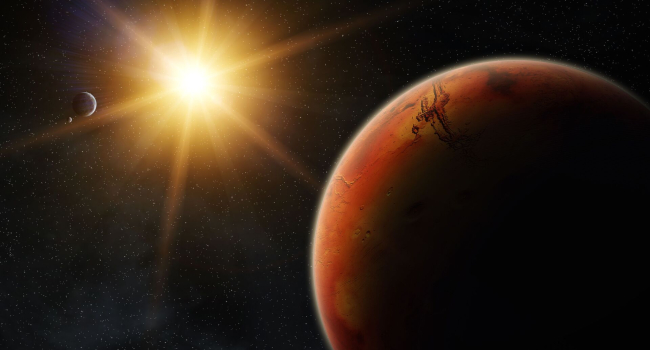
Scientists have made a major breakthrough in our understanding of Mars' ionosphere — the upper atmospheric layer where solar radiation generates charged particles. For the first time, researchers have obtained data on the state of the ionosphere near local Martian noon, a period that was previously inaccessible due to technical limitations. The findings, led by Jacob Parrott, were published in the Journal of Geophysical Research: Planets (JGRP).
An Innovative Research Method
Traditional radio sounding methods — where a satellite transmits signals to Earth — couldn’t observe the ionosphere during daylight hours because of the geometric alignment between the Sun, Mars, and Earth. Parrott’s team introduced a new approach called mutual radio occultation, in which radio signals were exchanged between two European Space Agency (ESA) orbiters: Mars Express and ExoMars Trace Gas Orbiter.
A total of 71 measurements were conducted, 35 of them during daytime, enabling scientists to obtain unique insights into the behavior of Mars’ ionosphere around noon.
Key Discoveries
The analysis revealed several unexpected characteristics of the Martian ionosphere:
- Electron Density: The maximum electron density in the upper atmosphere changes much more smoothly throughout the day than previously assumed. This suggests a more stable ionospheric dynamic.
- Persistence of the Lower Ionosphere: Contrary to expectations, the lower ionospheric layer remains intact at noon, rather than disappearing under intense solar radiation.
- Temperature Anomalies: The highest ionospheric temperatures occur closer to sunset, not at midday. Modeling indicates this is due to atmospheric circulation and Martian winds, rather than direct solar heating.
Scientific Importance
These findings significantly reshape our understanding of how Mars' atmosphere behaves and interacts with solar radiation. This has implications across several domains:
- Space Missions: The ionosphere affects radio communication and navigation systems for Martian satellites and rovers. Improved understanding can enhance reliability for future missions.
- Martian Climate Studies: The identified temperature patterns and air mass movements contribute to models of Mars' global atmospheric circulation, deepening our knowledge of its climate.
- Planning Human Missions: Knowing how the ionosphere behaves can help assess radiation exposure, which is critical for the safety of astronauts.
Outlook for Future Research
Researchers plan to continue observations using the mutual radio occultation technique to collect more data on seasonal and long-term changes in the ionosphere. There are also plans to integrate these findings with data from other missions, such as NASA’s MAVEN, to build a more complete and accurate model of Mars’ atmosphere.
This pioneering study marks a turning point in Martian atmospheric science — opening a new window into one of the planet’s most elusive and important layers.