make preferable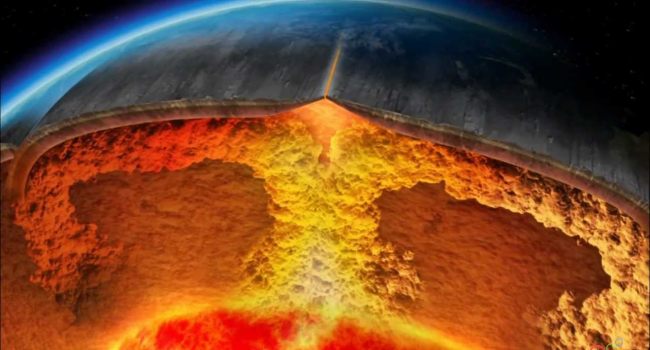
An international team of geologists from Saudi Arabia, Switzerland, India, China, and other countries has discovered a unique mantle plume that lacks any typical volcanic activity on the surface. This so-called “ghost” plume, named “Dani” after the region in Oman where it was found, could transform our understanding of the Earth’s thermal and tectonic dynamics. The findings were published in Earth and Planetary Science Letters (EPSL).
The “Dani” Plume: A Hidden Giant
Unlike traditional mantle plumes, which often reveal themselves through surface volcanism, the Dani plume operates silently and invisibly beneath the Earth’s crust. Seismic data collected in eastern Oman revealed a slowdown in seismic wave velocities, indicating the presence of a hot zone of rock deep underground. Additional measurements identified anomalies at the mantle’s transition zone — at depths of 410 to 660 km.
The plume is estimated to be 200–300 km in diameter and 100–300°C hotter than the surrounding mantle, yet it leaves no visible volcanic signature on the Earth’s surface.
Tectonic Influence
Researchers found that the Dani plume has been influencing continental movement for at least 40 million years. It contributes to the uplift of the Earth’s crust in the Oman region and likely plays a crucial role in the area's current tectonic behavior.
The discovery also challenges existing models of Earth’s internal heat flow. It suggests that the Earth’s core may release more heat than previously believed, warranting a reassessment of how thermal energy is exchanged between the core and the mantle.
Scientific Implications
The discovery of this “ghost” plume highlights the complexity of Earth’s internal thermal processes. Scientists suspect that similar hidden plumes may exist elsewhere on the planet — exerting tectonic influence without producing surface volcanism.
This revelation could reshape current geological theories on how heat from Earth’s core is transferred to the crust and help explain unusual tectonic anomalies in various regions.
Future Research
The research team, led by Simone Piliya from the King Fahd University of Petroleum and Minerals, plans to continue studying mantle plumes. They aim to determine whether other “ghost” plumes exist that might impact geological activity without visible volcanic signs.
These findings will refine our models of Earth’s evolution and tectonic behavior and may eventually redefine our understanding of the planet’s interior dynamics.
Conclusion
The discovery of the Dani plume in Oman shows that Earth’s interior still holds mysteries capable of reshaping scientific paradigms. This “ghost” plume not only influences continental drift but also highlights the need to revise theories of internal heat flow. Continued exploration of such anomalies promises deeper insights into how Earth forms, evolves, and operates as a living planet.