make preferable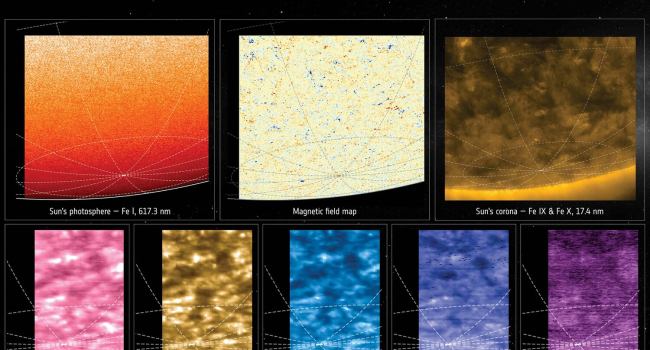
The European Space Agency's (ESA) Solar Orbiter has made a groundbreaking achievement by capturing the first-ever images of the Sun’s south pole. These unprecedented views, taken since February 2025, were made possible by the spacecraft’s unique orbit, tilted 17° relative to the solar equator. According to ESA’s official announcement, the newly acquired data could revolutionize our understanding of the Sun’s magnetic field, solar wind, and corona structure. Here's how the mission succeeded and what scientists have uncovered so far.
Why the Sun’s South Pole Matters
Until now, all solar observations were made from the "equatorial" plane, since Earth, other planets, and most satellites orbit the Sun within this narrow band. As a result, the Sun’s polar regions remained largely unexplored, despite being critical to several key solar processes:
- Solar wind formation — the stream of charged particles that influences space weather and Earth-based technologies.
- Magnetic field reversals — which drive the Sun's 11-year activity cycle.
- Rare phenomena — such as polar vortices, similar to those observed on Venus and Saturn.
Launched in 2020, Solar Orbiter is the first spacecraft capable of viewing the poles, thanks to a complex trajectory that uses Venus gravity assists to gradually tilt its orbit out of the solar equatorial plane.
How the South Pole Was Imaged
Since February 2025, Solar Orbiter has operated at a 17° tilt to the Sun’s equator, allowing it to peer over the southern limb. Three onboard instruments were key to these observations:
- PHI (Polarimetric and Helioseismic Imager)
- Captures visible-light images.
- Maps the Sun’s surface magnetic field.
- Detected unusual magnetic structures at the south pole.
- EUI (Extreme Ultraviolet Imager)
- Observes the corona in extreme ultraviolet light.
- Shows the superheated plasma of the outer atmosphere (temperatures in the millions of degrees).
- Revealed dynamic plasma motions in polar regions.
- SPICE (Spectral Imaging of the Coronal Environment)
- Analyzes the Sun’s atmospheric emissions at various altitudes and temperatures.
- Tracks particle flows being ejected from the surface.
Together, these instruments created a multi-layered portrait of the Sun, from its surface (photosphere) to its outer atmosphere (corona).
Key Discoveries
1. Magnetic Fields at the South Pole
In March 2025, with the spacecraft at a 15° inclination, PHI detected the simultaneous presence of magnetic fields of opposite polarity at the Sun’s south pole. This rare phenomenon is typical during the peak of the solar cycle — the current 25th cycle is expected to reach its maximum in 2025.
Significance: These findings help scientists better understand how the Sun’s magnetic field reorganizes and may improve predictions for the upcoming solar minimum, expected by 2030.
2. Solar Plasma Motion
SPICE measured the speeds of particles being ejected from the Sun’s surface. This allowed researchers to:
- Trace how the solar wind forms in polar regions.
- Identify plasma acceleration mechanisms that drive speeds of up to 800 km/s.
Significance: Understanding these processes can greatly improve space weather forecasts, helping protect satellites, power grids, and astronauts from geomagnetic storms.
3. Potential Polar Vortices
Scientists are searching for rotating plasma structures — polar vortices — akin to atmospheric cyclones seen on other planets. Although not directly confirmed yet, EUI data has shown unusual coronal gas motions that may hint at their existence.
Significance: These vortices could help explain how energy is transferred from the Sun’s surface to its outer layers.
Why This Mission Is a Breakthrough
1. A New Era in Heliophysics
- These are the first direct images of the Sun’s polar regions, previously studied only indirectly (e.g., via Ulysses in the 1990s).
- The data pave the way to understanding the Sun’s global magnetic architecture and its cyclical behavior.
2. Better Space Weather Forecasting
- The polar zones are a key source of solar wind that affects Earth.
- Accurate measurements will improve forecasting of geomagnetic storms that threaten critical infrastructure.
3. Stellar Magnetism Insights
- Studying the Sun’s poles provides clues about magnetic processes on other stars, crucial for astrophysics and the search for exoplanets.
4. Preparing for the Future
- In 2029, Solar Orbiter’s orbit will tilt to 33°, allowing even more detailed imaging of the solar poles — the mission’s anticipated high point.
How Solar Orbiter Works
- Orbit: The spacecraft uses Venus flybys to gradually increase its orbital inclination. Since its launch in 2020, it has performed several such maneuvers to reach the current 17° tilt.
- Instruments: Equipped with 10 scientific tools — including cameras, spectrometers, and particle detectors — capable of operating in extreme conditions (up to 500°C on the Sun-facing side).
- Heat Shield: A special shield coated with charred animal bones protects the instruments from intense solar radiation.
- Closest Approach: Solar Orbiter flies as close as 0.28 AU (42 million km) from the Sun — closer than Mercury.
What’s Next?
- 2025–2026: Continued observations from the current orbit. Scientists expect more data on polar vortices and solar mass ejections.
- 2029: Orbital tilt increases to 33°, enabling high-resolution imaging of both solar poles.
- Synergy with Other Missions: Data from Solar Orbiter will complement NASA’s Parker Solar Probe, which is approaching within 6 million km of the Sun.
- Space Weather Models: ESA aims to integrate Solar Orbiter’s data into forecasting systems to safeguard satellites and infrastructure on Earth.
Upcoming Missions: ESA’s Vigil (launching in 2027) will enhance solar activity monitoring.