make preferable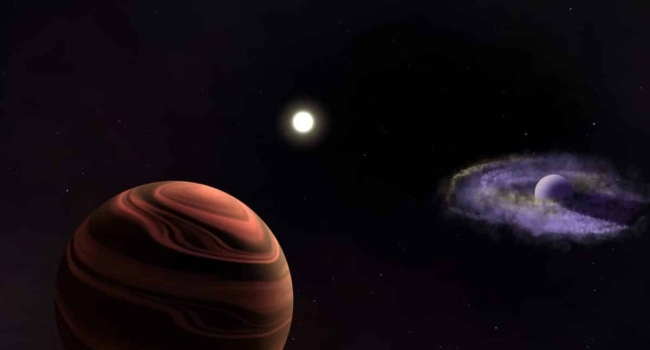
An international team of astronomers, using the James Webb Space Telescope (JWST), has made a groundbreaking discovery while studying the young stellar system YSES-1, located 360 light-years from Earth in the constellation Centaurus. The research, published in Nature, revealed unusual silicate clouds on exoplanet YSES-1c and a rare circumplanetary disk around YSES-1b, likely associated with the formation of moons. These findings reshape our understanding of planet formation and offer clues about the origins of our own Solar System.
What Is the YSES-1 System?
YSES-1 is a young stellar system, only 16.7 million years old — a cosmic "teenager" by astronomical standards. It hosts two known exoplanets:
- YSES-1b: A massive planet, about 14 times the mass of Jupiter, orbiting approximately 160 astronomical units (AU) from its star.
- YSES-1c: Less massive at 6 times the mass of Jupiter, located at a distance of 320 AU from the star.
Both planets exhibit unusual infrared "redness," hinting at unique atmospheric compositions or environmental conditions.
Key Discoveries
Silicate Clouds on YSES-1c
Using JWST’s infrared instruments NIRSpec and MIRI, scientists detected silicate particle clouds in YSES-1c’s atmosphere — similar in composition to sand. These particles are likely composed of magnesium silicates with possible iron content, as supported by computational models.
- Unprecedented Feature: YSES-1c shows the strongest silicate absorption feature ever observed on an exoplanet, strongly interacting with stellar light at wavelengths around 8–12 microns.
- Cause of Infrared Redness: These clouds scatter and absorb light in a way that explains the planet’s distinctive red spectral signature.
“This is the first direct observation of silicate clouds on a young exoplanet, making YSES-1c a unique laboratory for atmospheric studies,” the researchers noted.
Circumplanetary Disk Around YSES-1b
Around YSES-1b, scientists discovered a circumplanetary disk — a ring of gas and dust that likely feeds moon formation. Such features are rare, making this a major find:
- Rarity: As of 2025, only three such disks are known, and YSES-1b’s is the oldest, given the system’s age.
- Composition: The disk contains second-generation silicate particles, formed from collisions between satellite embryos — a sign of active moon formation.
- Significance: Observing this in a system nearly 17 million years old challenges assumptions about how long moons can take to form.
“Finding a circumplanetary disk in such a mature system is surprising and forces us to rethink the timescales for moon formation,” the team stated.
A Surprisingly Mature System
Despite its youth, YSES-1 exhibits signs of advanced development:
- The planets have already settled into stable orbits.
- Their atmospheres and disks show complex physical and chemical processes.
- The presence of silicate clouds and a circumplanetary disk suggests active evolution comparable to the early Solar System.
How the Study Was Conducted
JWST utilized its high-resolution instruments to analyze the light reflected and emitted by the exoplanets:
- NIRSpec (Near-Infrared Spectrograph) identified molecular signatures in the atmospheres.
- MIRI (Mid-Infrared Instrument) detected thermal emissions from silicate clouds and the disk at wavelengths between 5–28 microns.
- Direct Imaging: JWST’s sensitivity enabled it to capture direct images of the planets, reducing interference from their host star.
Computational modeling confirmed that the observed spectral features were due to silicates, rather than hydrocarbons or soot.
Why This Matters
- Understanding Planet Formation
- The silicate clouds and circumplanetary disk provide a real-time glimpse into processes similar to those that formed Jupiter and its moons.
- Discovering such an old disk suggests that moon formation may occur over longer timescales than previously thought.
- New Insights into Exoplanet Atmospheres
- YSES-1c’s clouds represent a new class of atmospheric phenomenon, likely common among young gas giants.
- Their strong light absorption improves our ability to analyze distant planetary atmospheres via spectroscopy.
- Context for Our Solar System
- The similarities between YSES-1 and our own early Solar System suggest that the latter's development may not have been unique, strengthening the theory of a “typical” solar evolution.
- Implications for Future Studies
- JWST's success highlights infrared spectroscopy as a key tool for investigating young exoplanets.
- This opens the door to studying similar systems like HR 8799 or VHS 1256 b, which also show signs of silicate clouds.
What’s Next?
Researchers plan to continue their investigation of YSES-1:
- In-Depth Cloud Analysis: Determining the exact composition of the silicates, including iron and magnesium content, and their atmospheric behavior on YSES-1c.
- Disk Evolution: Monitoring changes in the circumplanetary disk to estimate how quickly moons may form.
- Comparative Studies: Examining other exoplanets such as LTT 9779 b or WASP-107b to identify patterns in silicate cloud formation.
- New Instruments: Integrating JWST data with observations from ALMA (a radio telescope array) to study the system’s dust structures in greater detail.
Upcoming missions like SPHEREx (launching in 2025) will complement these findings by providing deeper insight into the chemistry and dynamics of young planetary systems.
Connection to Other Research
These discoveries align with previous JWST findings:
- In 2023, silicate clouds were also detected on VHS 1256 b (40 light-years away), causing similar infrared "redness" — reinforcing that such clouds are common in young gas giants.
- The HR 8799 system (130 light-years away) revealed carbon dioxide in planetary atmospheres, indicating complex chemistry.
- Observations of the HD 106906 dust disk (336 light-years) showed similar silicate particles to those found in YSES-1b’s disk, underscoring their role in moon formation.
Together, these findings are shaping a coherent picture of how young planetary systems evolve.