make preferable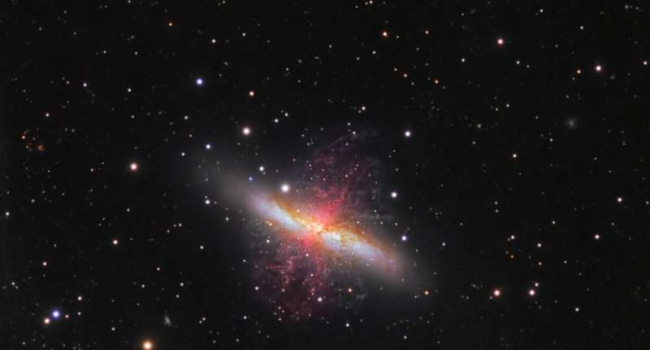
International research teams from the University of Padua, DESY, SLAC, and UC Berkeley conducted an extensive study to detect axions—hypothetical particles theorized to constitute dark matter. Published in Physical Review Letters (PRL), their findings unexpectedly revealed no signs of dark matter in the galaxy M82, known for its intense star-forming activity. Here’s what they discovered and how it impacts our understanding of one of the universe’s greatest mysteries.
What Is Dark Matter?
Dark matter is an enigmatic substance making up roughly 27% of the universe’s mass. It neither emits, absorbs, nor reflects light, rendering it nearly invisible to conventional observation methods. Its presence is inferred solely through gravitational effects, such as holding galaxies together, influencing their rotation, and shaping cosmic structures.
Axions, proposed in 1977 to address the strong CP violation problem in quantum chromodynamics, are leading candidates for dark matter. These lightweight particles are theorized to form in stellar cores, convert into photons (X-rays) in magnetic fields, and produce detectable radiation.
Why Study M82?
M82 (NGC 3034), a cigar-shaped galaxy in Ursa Major, lies 12 million light-years from Earth. Known as a starburst galaxy, it hosts rapid star formation, with dozens of new stars born annually in its core. This makes M82 an ideal “laboratory” for axion searches, as scientists hypothesized that axions generated in its hot stellar cores could transform into X-ray photons in the galaxy’s magnetic fields, creating a detectable “glow.”
How Was the Study Conducted?
Two independent teams used the NuSTAR (Nuclear Spectroscopic Telescope Array), a highly sensitive X-ray telescope operating in the 3–79 keV energy range. They analyzed X-ray images of M82 to identify excess radiation that might indicate axion decay.
The methodology involved:
- Axion-to-Photon Conversion: Axions produced in stars could transform into photons in strong magnetic fields (the Primakoff effect).
- Spectral Lines: These photons would produce a narrow X-ray spectral line, dependent on the axion’s mass.
- Data Analysis: Researchers searched for such lines in M82’s spectrum, comparing them to background radiation while accounting for interference from sources like black holes, neutron stars, or hot gas.
Observations were conducted with high precision to minimize noise from other X-ray sources.
Results: No Axions Detected
Surprisingly, no evidence of axions was found in M82. Neither team detected the characteristic spectral lines expected from axions converting into X-ray photons. This suggests either that axions are not produced in M82’s stars in anticipated quantities or that their mass and properties lie outside the studied range.
Far from a failure, the absence of a signal provided valuable insights, significantly narrowing the axion parameter space:
- Axion masses in the range of approximately 10⁻⁶ to 10⁻⁵ eV, where detection was expected, were ruled out.
- Constraints were placed on the axion-photon coupling constant (g_aγ), refining the search parameters.
These findings mark a critical step in clarifying the properties of dark matter and its potential candidates.
Why It Matters
- Narrowing the Search:
- Excluding certain axion masses directs researchers toward other ranges or alternative dark matter candidates, such as WIMPs (Weakly Interacting Massive Particles) or sterile neutrinos.
- Tighter constraints on axion-photon interactions refine models of their production in stars.
- Insights into Starburst Galaxies:
- M82’s lack of axion signatures may point to unique conditions in its core, such as weaker magnetic fields or lower axion density.
- This raises questions about the role of magnetic fields in axion conversion and their impact on X-ray emissions.
- Advancing Cosmology:
- The study underscores the complexity of dark matter, with even null results providing crucial data for building more accurate universe models.
- Methodological Progress:
- NuSTAR’s effectiveness in axion searches validates X-ray astronomy as a powerful tool for studying dark matter, applicable to other galaxies or objects like galaxy clusters or neutron stars.
What’s Next?
The teams plan to expand their axion search:
- New Targets: Studying other starburst galaxies, neutron stars, or galaxy clusters with stronger magnetic fields.
- Additional Telescopes: Employing Chandra, XMM-Newton, or the upcoming XRISM for more sensitive X-ray line searches.
- Alternative Approaches: Investigating axion interactions with other particles (e.g., electrons) or their effects on stellar evolution.
- Laboratory Experiments: Projects like ADMX (Axion Dark Matter eXperiment) and CAST (CERN Axion Solar Telescope) will complement astrophysical observations by testing axions in controlled settings.
The findings may also prompt revisions to theoretical models. If axions are not produced in M82’s stars, their properties may need reevaluation, or other dark matter candidates may gain prominence.
Connections to Other Research
This study aligns with broader dark matter research:
- In 2024, the LUX-ZEPLIN experiment ruled out WIMPs in certain mass ranges, boosting interest in axions.
- Fermi-LAT observations of the Milky Way’s center detected excess gamma-ray emissions, potentially linked to dark matter decay, though unconfirmed.
- Galaxy NGC 1277 (220 million light-years away) showed a dark matter deficit, possibly related to processes observed in M82.
These findings highlight the complexity of dark matter searches and the need for a multifaceted approach.
Conclusion
The search for axions in M82 using NuSTAR found no evidence of dark matter, yet it advanced scientific understanding. By narrowing the possible masses and interaction parameters of axions, the study ruled out their presence in M82’s stars. This underscores the unique nature of starburst galaxies and the elusive nature of dark matter. With new telescopes and methods, researchers are edging closer to unraveling one of the universe’s greatest mysteries.