make preferable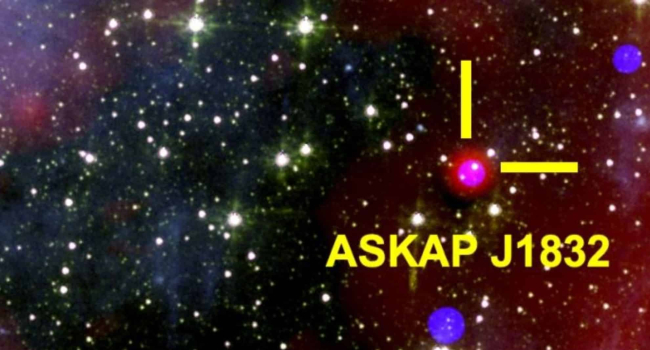
An international team of astronomers has discovered a unique cosmic object in the Milky Way that emits synchronized pulses of radio waves and X-rays with astonishing regularity. Named ASKAP J1832-0911, the object is located approximately 15,000 light-years from Earth. The study, published in Nature, marks the first observation of a long-period transient (LPT) that emits in both bands simultaneously, potentially pointing to a new class of cosmic bodies.
What Is ASKAP J1832-0911?
The object emits powerful two-minute bursts of radio and X-ray radiation every 44 minutes. This strict periodicity sets it apart from known astrophysical sources such as pulsars, which emit in milliseconds or seconds.
- Classification: ASKAP J1832-0911 belongs to the rare class of long-period transients (LPTs), first discovered in 2022. LPTs emit radio pulses at intervals ranging from minutes to hours. Only about 10 such objects are known today.
- Uniqueness: This is the first LPT observed to emit synchronized X-rays and radio waves, making it a one-of-a-kind discovery.
“This object is unlike anything we’ve seen before,” said lead author Ziteng (Andy) Wang from Curtin University, Australia.
How Was It Discovered?
The discovery was the result of a fortunate overlap in observations:
- ASKAP Radio Telescope (Australia): First detected radio pulses from the object. As part of the Square Kilometre Array (SKA) project, ASKAP's wide field of view enables scanning of large sky areas.
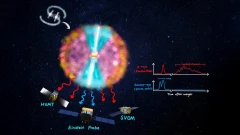
- Chandra X-ray Observatory (NASA): Happened to be observing the same region and detected synchronized X-ray bursts.
“Finding the X-rays was like finding a needle in a haystack,” said Wang.
- Confirmation: Radio emissions during X-ray bursts were confirmed by the MeerKAT (South Africa) and GMRT (India) radio telescopes.
Combined observations revealed the object has a compact structure (as indicated by X-rays) and a highly organized magnetic field (suggested by the radio waves).
Possible Explanations
Scientists have proposed several hypotheses for the nature of ASKAP J1832-0911, though none fully explain all the observed phenomena:
- Magnetar: An ultra-dense stellar remnant with an extremely powerful magnetic field. However, known magnetars emit on much shorter timescales (seconds), making the 44-minute cycle unusual.
- Binary System: The object could be a system involving a white dwarf (a magnetized stellar remnant) and a companion star. Yet the synchronized radio and X-ray emissions are atypical for such systems.
- New Class of Objects: ASKAP J1832-0911 may represent an entirely unknown type of cosmic body, potentially requiring a revision of stellar evolution models — or even new physics.
“Discovering one such object hints at many more,” said co-author Nanda Rea from the Institute of Space Sciences in Spain.
Why Is This Important?
- New Physics: The synchronized emission in two bands contradicts current models and may lead to new insights into matter under extreme conditions.
- Stellar Evolution: Understanding LPTs will clarify processes in neutron stars, white dwarfs, or other compact objects.
- Cosmic Beacons: LPTs like ASKAP J1832-0911 serve as natural laboratories for studying magnetic fields and plasma behavior.
- Future Discoveries: The success of ASKAP and Chandra in observing this event encourages further LPT searches, potentially revealing more such phenomena in the Milky Way.
Technical Details
- Location: The object lies within the galactic plane, a region crowded with stars, gas, and dust — making observations difficult.
- Emissions:
- Radio waves suggest a structured magnetic field.
- X-rays indicate high energy and compactness — the object is likely less than 20 km in diameter.
- Periodicity: Each burst lasts 120 seconds and recurs every 2,640 seconds (44 minutes), which is highly unusual.
- Instruments:
- ASKAP: 50 μJy sensitivity, 30-square-degree field of view.
- Chandra: 0.5 arcsecond resolution, 0.2–10 keV energy range.
- MeerKAT & GMRT: Detected emissions in the 1–2 GHz frequency range.
Limitations and Future Outlook
- Uncertainty: Lack of optical and infrared data limits our understanding.
- Observation Timing: The ASKAP–Chandra alignment was coincidental, highlighting the need for coordinated campaigns.
- Future Research:
- Integration with telescopes like SKA (next-gen ASKAP phase) and XMM-Newton to find similar objects.
- Modeling of magnetospheres and plasma dynamics to explain the 44-minute cycle.
Conclusion
The discovery of ASKAP J1832-0911, emitting synchronized radio and X-ray pulses every 44 minutes, is a groundbreaking event in astronomy. Found by ASKAP and Chandra, this object doesn’t fit into existing models and may represent a new class of cosmic phenomena. The study, published in Nature, highlights the uniqueness of this celestial "beacon" and opens new paths for discovery in our galaxy. Astronomers are continuing observations in hopes of uncovering the true nature of this enigmatic source — which could ultimately reshape our understanding of the universe.