make preferable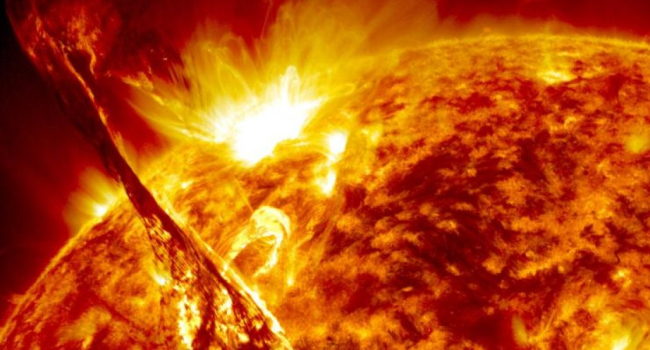
Scientists from the Solar Astronomy Laboratory of the Space Research Institute (IKI) and the Institute of Solar-Terrestrial Physics (ISTP) of the Russian Academy of Sciences have reported a major plasma ejection near the Sun’s south pole, recorded on June 8, 2025, at 11:00 AM Moscow time. This marks the second large-scale event in a week, following the early June eruption that triggered a record-setting geomagnetic storm.
What Happened?
A large and unusually dense cloud of plasma was released near the Sun’s southern pole, caused by the destabilization of a giant solar prominence — a structure of hot plasma held in place by magnetic fields. The prominence was located on the far side of the Sun, so the ejection wasn't directly visible from Earth. However, its rise over the solar limb was captured by several orbital telescopes, including NASA’s SDO and ESA/NASA’s SOHO.
- Scale: The eruption is comparable to the May 31, 2025 event that triggered a 66-hour G4-class geomagnetic storm — the longest since 2017.
- Cause: Heightened solar activity during Solar Cycle 25, which is nearing its peak (2025–2026).
Impact on Earth
Since the eruption occurred on the far side of the Sun, it is not directed at Earth and won’t cause geomagnetic storms in the coming days. This distinguishes it from the May 31 event, when plasma traveling at 1,200 km/s reached Earth in 37 hours, causing strong geomagnetic disturbances.
- Geomagnetic Storms: As of June 9, 2025, no new storms are expected, though scientists continue to monitor the situation due to the Sun’s high activity.
- Auroras: No significant auroral enhancements, like those in May 2024, are currently predicted.
- Space Weather: The ejection may alter the interplanetary environment, but the risk to satellites or power systems is minimal.
Solar Activity in 2025
The Sun is experiencing a peak in activity, accompanied by a series of intense events:
- May 2024: X-class solar flares triggered a G5-level storm, the first in 20 years.
- May 31, 2025: An M8.2-class eruption caused a G4 storm that lasted 66 hours until June 3.
- June 8, 2025: The current eruption confirms the Sun’s abnormal activity.
According to Sergey Bogachev, head of the solar astronomy lab, the frequency of such events in 2025 is higher than expected, though extreme G5-class storms are unlikely in the coming weeks.
Why This Matters
- Solar Physics: Studying prominences and plasma ejections helps reveal the mechanisms behind the Sun’s magnetic fields — crucial for understanding the solar cycle.
- Space Weather: Accurate data from telescopes improves geomagnetic storm forecasting, protecting technology and human health.
- Technology: Understanding solar eruptions reduces the risk to satellites, power grids, and GPS — as seen in May 2024.
Potential Risks
High solar activity still poses threats:
- Satellites: Energetic particles can damage electronics, as noted by Nathan Eismont from IKI RAS.
- Power Grids: G4–G5 storms can disrupt electricity distribution.
- Health: People sensitive to geomagnetic changes may feel unwell during storms.
Conclusion
The plasma eruption on June 8, 2025, near the Sun’s south pole, recorded by scientists at IKI and ISTP, is one of the most significant in recent years. Originating from a prominence on the Sun’s far side, it poses no threat to Earth but underscores the peak of Solar Cycle 25. Following the 66-hour storm in early June, this is the second major solar event within a week, requiring ongoing observation.