make preferable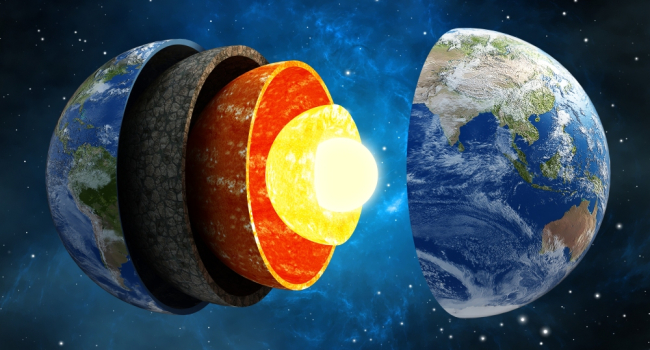
An international team of scientists led by Professor Motohiko Murakami from the Swiss Federal Institute of Technology (ETH Zurich) has made a breakthrough discovery: solid rock in the D″ zone, located about 2,900 km deep at the boundary between Earth's mantle and core, flows despite not being in a liquid state. The research, published in Communications Earth & Environment (CEE), explains the mysterious behavior of seismic waves and confirms convection of solid rock in the planet's interior. This discovery changes our understanding of Earth’s internal dynamics.
What Is the D″ Zone and Why Is It Mysterious?
The D″ zone is a 100–300 km thick layer located between the lower mantle and the Earth's outer core at a depth of 2,600–2,900 km. For half a century, scientists have observed that seismic waves (P- and S-waves) unexpectedly accelerate in this region, indicating unusual material properties. Leading hypotheses linked this phenomenon to a phase transition of the main lower mantle mineral—perovskite (MgSiO₃)—into a denser form known as post-perovskite under extreme conditions: pressures up to 135 GPa and temperatures around 4,000 K.
In 2004, Murakami confirmed that such a transition occurs, but in 2007 he also showed that the phase transition alone did not explain the seismic wave speed anomaly. The puzzle remained unsolved until the latest study.
How Did Scientists Solve the Mystery?
Murakami’s team used a combination of computer modeling and laboratory experiments to study the D″ zone:
- Modeling:
- Using molecular dynamics and quantum mechanical calculations, the team modeled the behavior of perovskite and post-perovskite under the pressure and temperature conditions typical of a depth of 2,700 km.
- The models showed that seismic wave acceleration is only possible with anisotropy—when mineral crystals are aligned in a single direction, creating a "fast" axis for wave propagation.
- Experiment:
- In the lab, using diamond anvil cells (DACs), scientists recreated the pressure and temperature of the D″ zone by compressing perovskite samples.
- For the first time, they succeeded in aligning post-perovskite crystals through deformation mimicking rock flow.
- X-ray diffraction measurements confirmed a jump in S-wave speeds, matching those observed in nature (an increase of about 3–5%).
- Key Discovery:
- Solid rock in the D″ zone flows like a viscous liquid without melting. This process, called solid-state convection, is driven by temperature and pressure gradients at the core-mantle boundary.
- The movement of rock aligns post-perovskite crystals in a uniform orientation, creating anisotropy that accelerates seismic waves.
“We found the missing piece of the puzzle,” Murakami stated, emphasizing that this is the first experimental proof of solid-state convection in the mantle.
Why Does the Rock Flow?
The flow of solid rock in the D″ zone is driven by extreme conditions:
- Temperature: The gradient between the hot outer core (~6,000 K) and the cooler mantle (~3,500 K) causes thermal convection.
- Pressure: Enormous compression makes post-perovskite plastic, allowing its crystals to deform and "flow" at a rate of ~1–10 cm per year.
- Dynamics: The rock moves along the core boundary like boiling water in a pot, forming global currents linked to mantle plumes and subduction.
This process not only explains seismic anomalies but also irregularities in the D″ zone, such as ultra-low velocity zones (ULVZs) and large low-shear-velocity provinces (LLSVPs).
Significance of the Discovery
- Understanding Earth’s Interior:
- Solid rock convection confirms the dynamic nature of the mantle, linking plate movement, volcanism, and Earth’s magnetic field.
- The D″ zone acts as a “boundary layer” regulating heat exchange between the core and mantle.
- Seismic Models:
- Refined data on post-perovskite anisotropy will improve the interpretation of seismic tomography, enabling the creation of 3D maps of flow in the D″ zone.
- This will aid in forecasting geodynamic processes like mantle plumes that power hotspots (e.g., Hawaii, Iceland).
- Planetology:
- Similar processes may occur on other planets, such as Mars or super-Earths, where pressure and temperature create comparable conditions.
- The discovery enhances models of planetary formation and their magnetic fields.
- Technological Breakthrough:
- Diamond anvil cell experiments and supercomputer modeling set a new standard for studying Earth's deep interior.
Limitations and Future Prospects
- Scale: Experiments are limited to small samples (~1 mm³), while the D″ zone is heterogeneous over thousands of kilometers.
- Data: A full flow map requires additional seismic stations, especially in oceans (e.g., the Ocean Bottom Seismology project).
- Future Research:
- Scientists plan to study the role of chemical composition (e.g., iron impurities) in convection.
- Integration with data from the InSight mission on Mars may reveal similarities in mantle dynamics.
Conclusion
Motohiko Murakami’s study, published in Communications Earth & Environment, reveals that solid rock in the D″ zone at the core-mantle boundary flows, aligning post-perovskite crystals and accelerating seismic waves. This is the first evidence of solid-state convection confirmed through diamond anvil experiments and modeling. The discovery reshapes our understanding of geodynamics, promising 3D maps of Earth’s interior and new insights into planetary science. Stay tuned to geoscience—our understanding of how our planet works from the inside is just beginning.