make preferable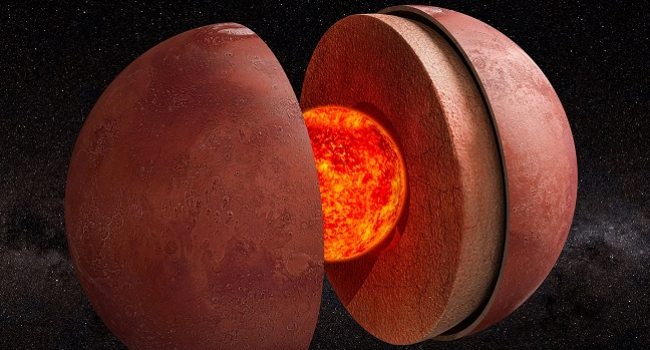
NASA scientists have made a surprising discovery: Mars’ core formed in just a few million years—much faster than Earth’s—and it may smell like rotten eggs due to a high sulfur content. The study, conducted at the Johnson Space Center and published in Nature Communications, sheds new light on the early evolution of Mars and other planetary bodies.
How Did Mars’ Core Form?
Planetary cores typically take billions of years to form. Heavy elements like iron and nickel slowly sink to the center of a molten planet, driven by gravity and sustained by radioactive decay.
But new analyses of Martian meteorites suggest that Mars’ core formed rapidly—just a few million years after the birth of the Solar System (around 4.5 billion years ago).
Led by Sam Crossley, the NASA team simulated early Martian conditions:
- Sulfur-rich rock samples were heated to 1020°C under pressures up to 10 GPa—matching Mars’ mantle conditions.
- Molten iron and nickel sulfides flowed through microscopic cracks in silicate rocks, quickly reaching the planet’s center.
These findings were backed by meteorites like Chassigny and Nakhla, which contain platinum group metals (e.g., osmium, iridium) in patterns that matched lab results. This suggests that sulfide melts were crucial to the planet’s unusually fast core formation.
Why Does the Core Smell Like Rotten Eggs?
Mars’ core is thought to contain 15–20% sulfur by mass, significantly higher than Earth’s. This sulfur likely exists in the form of:
- Hydrogen sulfide (H₂S) — a gas known for its distinct rotten egg smell.
- Sulfide minerals like FeS (iron sulfide) and NiS (nickel sulfide), which played key roles in core formation.
Although we can’t access the Martian core directly, models and meteorite chemistry suggest:
- The core’s sulfur content is extremely high, explaining its unique composition.
- “If we could smell Mars’ core,” scientists joke, “it would stink like rotten eggs.”
Why This Discovery Matters
1. Planetary Evolution
- The rapid formation of Mars’ core may explain why the planet lost its magnetic field early on.
- Unlike Earth, which still has a geodynamo-powered magnetic field, Mars’ interior cooled quickly, halting magnetic activity.
- Similar fast core formation may have occurred on Mercury or large asteroids like Vesta.
2. Magnetic Fields
- Understanding Mars’ core composition can help reconstruct its ancient magnetic field—which once protected the atmosphere and possibly allowed liquid water to exist on the surface.
3. Search for Life
- The core’s makeup influences the mantle’s geochemistry and the availability of volatile compounds like water and carbon, both essential for life.
- This adds support to the theory that Mars may once have been habitable.
4. Cosmochemistry and Exoplanets
- Sulfide-rich melts may have played a similar role in the cores of other planets and exoplanets, refining our understanding of how planetary interiors form and evolve.
How the Study Was Conducted
- Meteorite Analysis: Researchers studied shergottites (Martian meteorites) with anomalous levels of platinum-group elements, indicating sulfide-driven metal separation.
- Lab Experiments: Using high-pressure furnaces, they recreated Martian mantle conditions and tracked how sulfides migrated through rock samples.
- Computer Simulations: Models showed that sulfide melts could reach Mars’ center in 1–10 million years—100x faster than Earth’s core formation timeline.
What’s Next?
This discovery raises new questions:
- How did the sulfur-rich core contribute to Mars’ atmospheric loss?
- Can H₂S traces in surface rocks be tied to past volcanic or hydrothermal activity?
- How can this data support future missions like Mars Sample Return (2028–2031)?
Future investigations will build on:
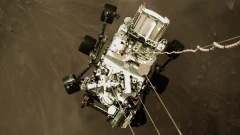
- Perseverance rover missions, analyzing surface chemistry and rock samples.
- Mars InSight mission data (2018–2022), which provided seismic evidence for a smaller-than-expected core (radius ~1,830 km) with high density due to sulfur.
Conclusion
The idea of Mars having a rotten egg–smelling core may seem humorous, but it highlights serious insights into the Red Planet’s deep history. The sulfur-rich core tells a story of rapid planetary formation, early magnetic loss, and a once-dynamic world with the potential to support life. With new missions on the horizon, scientists are closer than ever to unraveling Mars’ buried secrets—and perhaps even understanding how other worlds beyond our Solar System are built.