make preferable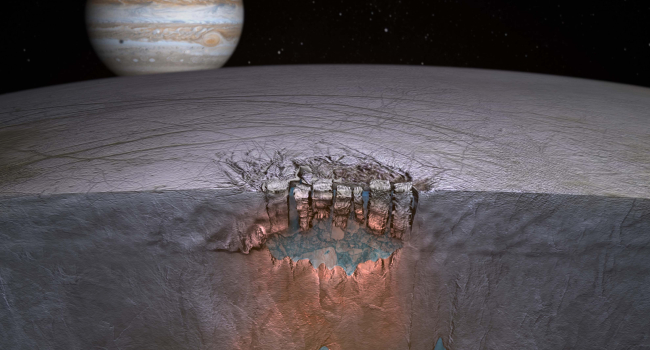
American scientists from the Southwest Research Institute (SWRI) and other institutions, using the James Webb Space Telescope (JWST), have discovered unusual processes on Europa, Jupiter’s icy moon. Their research reveals that the subsurface ocean is actively pushing fresh ice to the surface, constantly renewing it. The results were published on SWRI’s website.
Crystalline Ice Defies Radiation
The scientists expected Europa’s surface ice—constantly bombarded by Jupiter’s intense radiation—to be entirely amorphous, lacking a structured crystal lattice. However, JWST data revealed areas of crystalline ice, indicating the recent arrival of material from within the moon.
The presence of crystalline ice on Europa’s surface is a surprise. Radiation should destroy its structure within days, said lead author Samantha Trillo of SWRI.
Crystalline ice typically survives only about 15 days before becoming amorphous under the bombardment of charged particles. This means the surface is being refreshed at a high rate.
The Mysterious Chemistry of the Tara Region
Scientists paid particular attention to a region known as Tara—an area with chaotic terrain and known geological activity. Spectral analysis revealed the presence of:
- Crystalline ice
- Sodium chloride (table salt)
- Hydrogen peroxide (H₂O₂)
- Carbon dioxide (CO₂)
The chemistry of Tara is incredibly strange and intriguing. It's like an open-air laboratory, emphasized co-author Richard Cartwright of Johns Hopkins University.
The salt and hydrogen peroxide may originate from the subsurface ocean, making Tara a key site for studying Europa’s interior. The carbon dioxide likely has an endogenous origin, potentially linked to volcanic or hydrothermal activity.
How Does the Ocean Refresh the Surface?
Researchers proposed two mechanisms for how the surface is renewed:
- Ice Chimneys: Warm water from the ocean rises through cracks in the roughly 30 km thick ice crust, pushing fresh material upward. Upon reaching the surface, it instantly freezes into crystalline ice.
- Geyser Eruptions: Similar to plumes observed on Saturn’s moon Enceladus, Europa may eject water vapor and liquid that settles as ice on the surface.
Heat sources that maintain the ocean’s liquid state:
- Tidal forces: Jupiter’s gravity deforms Europa’s interior, generating heat.
- Radioactive decay: Elements in Europa’s core release additional energy.
These processes maintain a liquid ocean beneath an ice shell that may hold 2–3 times the volume of all Earth's oceans.
Scientific Significance
This discovery strengthens the hypothesis that Europa’s subsurface ocean is one of the most promising locations in the Solar System for finding extraterrestrial life. The surface composition of the Tara region—including salt and organic-related compounds—suggests chemical activity akin to hydrothermal vents on Earth.
Europa is a dynamic world where the ocean interacts with the surface. This makes it a high-priority target for future missions, noted Trillo.
However, Jupiter’s radiation (up to 5.4 Sv/day) complicates exploration, breaking down molecules and generating oxidants like H₂O₂. This also affects the moon’s potential habitability, as any microbes would need protection from the harsh environment.
Future Research
JWST data builds on earlier observations by the Galileo and Voyager probes, but further missions are needed to confirm current hypotheses:
- Europa Clipper (NASA): Launched in October 2024, expected to arrive at Jupiter in 2030. The probe will study the composition of Europa’s ice and ocean, and its geological activity.
- JUICE (ESA): Launched in 2023, arriving in 2029. The mission will focus on Europa, Ganymede, and Callisto.
These missions will help determine whether Europa’s ocean contains biosignatures such as amino acids, and how active the geysers are.
Conclusion
The discovery of crystalline ice and Europa’s unusual surface chemistry reshapes our understanding of icy moons. A subsurface ocean refreshing the surface through "chimneys" and geysers makes Europa one of the most active worlds in the Solar System. The Tara region serves as a “window” into the moon’s depths, hinting at complex processes that could support life. Future missions will determine whether this icy world holds the secrets of extraterrestrial biology—but even now, Europa stands out as truly unique.