make preferable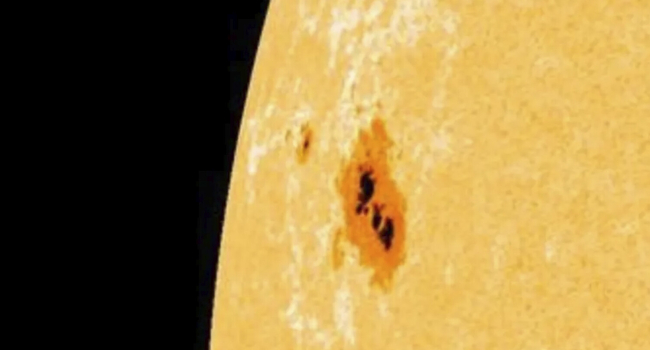
The giant sunspot AR14100, nicknamed the “pensioner” for its unusual longevity, continues to surprise astronomers. First observed on April 5, 2025, under the designation AR14055, it has now appeared for the third time on the Sun’s visible side, according to Spaceweather.com. The spot demonstrates exceptional stability, having persisted for nearly two months, making it a candidate to break the record set in 1919.
Characteristics and Evolution of AR14100
- Size: At its peak in early May (when it was designated AR14079), the spot reached a diameter of 140,000 km — 11 times the size of Earth. It has since shrunk by nearly half but remains active.
- Duration: Since its appearance on April 5, the sunspot has existed for around 60 days (as of June 2, 2025). The historical record belongs to a spot from 1919 that lasted 134 days. To break that record, AR14100 must survive for another 2–3 months.
- Orbit: The spot has crossed the Sun’s visible side three times, returning after two-week “journeys” across the star’s far side. It appeared as AR14055 (April 5), then as AR14079 (April 28), and finally as AR14100 (May 26).
- Activity: The spot has triggered several flares, including a powerful M8.2-class flare on May 31, accompanied by a coronal mass ejection (CME) that caused a G4-level geomagnetic storm on Earth on June 1.
Sunspots form when magnetic fields break through the Sun’s surface, creating cooler (around 3500–4500°C vs. 5500°C) and darker regions. AR14100 is an "active region," made up of many smaller spots combined into a complex magnetic structure.
The Peak of Solar Cycle 25
AR14100 appeared during the peak of the 25th 11-year solar cycle, which has proven much more intense than predicted. In August 2024, a record was set: 337 spots were recorded in a single day, underscoring the Sun’s unusual activity. This cycle has produced X-class flares (the most powerful) and several geomagnetic storms, including G5-level events in May 2024.
The magnetic complexity of AR14100 (classified as beta-gamma) makes it capable of producing moderate to strong flares, though its size alone doesn’t guarantee danger. Scientists note that magnetic field configuration plays a more crucial role than size.
Record-Breaking Potential
The longevity record, set by the 1919 spot (134 days), has stood since the early 20th century. AR14100, currently about 60 days old, shows rare stability, withstanding solar radiation, magnetic shifts, and the star’s rotation.
“I’m curious how long this spot will stay with us,” said amateur astronomer Harald Paleske of Germany, who has been photographing AR14100 since April. “This is its third journey across the Sun,” he told Spaceweather.com. The spot remains stable despite its reduced size, making it a unique phenomenon.
Impact on Earth
AR14100 has already shown its power:
- 2 Flare (May 31): This long-duration flare lasted over 3 hours, causing a CME that reached Earth at 05:42 UTC on June 1. The solar wind speed exceeded 1000 km/s, and the geomagnetic storm reached G4 level, triggering auroras at mid-latitudes and radio communication disruptions.
- Radiation Storm: High-energy particles from the flare caused a moderate S2-level radiation storm, affecting satellites.
Although the spot has shrunk, it still has the potential to produce new flares. NOAA forecasts a G3–G4 storm on June 2, with a decline to G1 by June 3.
Scientific Importance
AR14100 attracts scientific interest for several reasons:
- Rare Longevity: Sunspots rarely survive more than one solar rotation (27 days). AR14100’s triple return makes it a valuable case for studying magnetic stability.
- Cycle Peak: The spot provides insights into solar behavior at the peak of Cycle 25, which may continue through mid-2025.
- Observation Technology: New tools like the Daniel K. Inouye Telescope allow detailed studies of the spot’s structure, improving space weather forecasting.
Outlook
To break the 1919 record, AR14100 must persist through August–September 2025. Scientists believe this is possible given its current stability. “It might just do it,” notes Spaceweather.com. Observations with NASA’s SDO and other instruments continue to track the spot’s evolution.
If AR14100 continues to exist, it will go down in history as one of the longest-lived sunspots, highlighting the unpredictable nature of solar activity. It also serves as a reminder of the need to enhance satellite and power grid protections during solar cycle peaks.