make preferable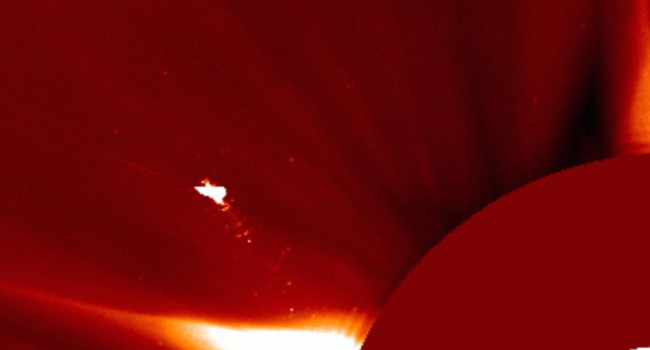
On May 24, 2025, the LASCO telescope on the SOHO solar observatory captured an unusual object resembling a giant “firebird.” The image, shared by the Solar Astronomy Laboratory of the Institute of Space Research (IKI) of the Russian Academy of Sciences, sparked widespread interest: the object, with a wing-like structure and a bright trail, appeared otherworldly. Its “wingspan” measured about 150,000 kilometers, and it was located roughly 2,000 kilometers above the Sun’s surface. Larger than Earth by more than ten times, it fueled speculation, including theories about extraterrestrials and plasma-based life.
Astronomer’s Explanation
Astronomer and science communicator Alexander Kiselev dispelled the rumors, clarifying the phenomenon’s nature. “This is most likely a sungrazing comet passing very close to the Sun,” he told Arguments and Facts. According to Kiselev, the object’s elongated shape and the bright dots trailing it suggest active evaporation or even disintegration of the comet under extreme solar temperatures. Sungrazing comets, or “sungrazers,” approach the Sun within 2 million kilometers, where their icy cores heat up, releasing gas and dust that form a distinctive tail.
Why Does the Comet Look Like a Bird?
The object’s unusual shape in the image is due to its proximity to the Sun. High temperatures cause volatile substances, such as water and carbon dioxide, to evaporate, creating a bright trail. In the LASCO image, this trail and fragments of the disintegrating core formed the illusion of “wings” and a “fiery trace.” Kiselev noted that such phenomena are rare, as most sungrazing comets completely disintegrate, leaving no trace.
Context of Solar Activity
The discovery occurred amid heightened solar activity. On the night of May 25, 2025, a powerful X-class solar flare, the highest category, was recorded, but it was not accompanied by plasma or particle ejections that could affect Earth. Forecasts for May 26 indicated a calm magnetosphere, with a 25% chance of geomagnetic disturbances and only a 12% chance of storms. The geomagnetic index, at 3.5, suggested no threat, even for weather-sensitive individuals. This underscores that the “firebird” is unrelated to solar flares and poses no danger.
Scientific Significance
Sungrazing comets, like the one observed, are valuable for science. Studying them helps understand the composition of comets originating from distant regions of the Solar System, such as the Oort Cloud. The LASCO telescope, designed to observe the Sun’s corona, regularly detects such objects, but bright and unusual structures like this are rare. For example, Comet Lovejoy (C/2011 W3) in 2011 survived a close encounter with the Sun, losing its tail but retaining brightness, which also drew scientific attention.
Researchers encourage amateur and professional astronomers to search LASCO archives for similar images to refine the frequency of such events. “If someone finds structures resembling a bird with a plasma trail, it would be a significant contribution,” the Solar Astronomy Laboratory noted.
Alternative Hypotheses
While Kiselev is confident in the comet explanation, some scientists offered other theories. Evgenia Kravchenko from MIPT suggested it could be a coronal mass ejection that took an unusual shape due to an optical effect. However, the object’s absence in subsequent frames, taken 10 minutes apart, makes this less likely, as comets can quickly vanish from view due to disintegration or movement.