make preferable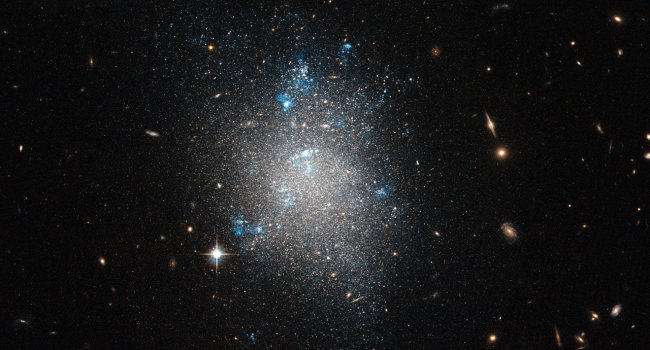
Chinese astronomers from the University of Science and Technology of China, led by Professor Wang Huiyuan, have uncovered an unusual pattern in the distribution of dwarf galaxies—the smallest and dimmest objects in the universe. Their study, published in Nature, reveals that these galaxies cluster in a way that contradicts the current cosmological model, raising questions about our understanding of the universe’s structure and the nature of dark matter.
Why Are Dwarf Galaxies Important?
Until recently, scientists focused on studying large galaxies like the Milky Way due to their brightness and observability. Dwarf galaxies, by contrast, remained overlooked because of their faintness. However, this new research shows that these galaxies may hold the key to understanding fundamental processes shaping the universe.
The astronomers found that dwarf galaxies fall into two categories: compact (dense) and diffuse (sparse). Surprisingly, diffuse galaxies are far more likely to form clusters than compact ones, which contradicts expectations based on the standard cosmological model, ΛCDM (Lambda Cold Dark Matter).
Conflict with the Theory
According to the ΛCDM model, galaxies form within halos of dark matter—invisible clouds that hold stars and gas together. It was believed that older halos, formed in the early universe, produce dense dwarf galaxies, while younger halos create more sparse ones. However, the study revealed the opposite: diffuse galaxies are associated with older halos, and compact galaxies with younger ones. This finding challenges the existing theory and suggests gaps in our understanding of dark matter.
A New Hypothesis About Dark Matter
To explain this phenomenon, the researchers proposed a hypothesis of self-interacting dark matter. Unlike the traditional view, where dark matter particles interact only through gravity, the new model suggests additional types of interactions. Such processes could weaken gravitational attraction in older halos, “inflating” galaxies and making them more diffuse. This idea could fundamentally reshape our understanding of dark matter, which accounts for about 27% of the universe’s mass.
Scientific Significance
The editors of Nature called the study “original and surprising,” noting that it introduces a new way to investigate dark matter through galaxy distribution analysis. The research provides the first observational confirmation of the “halo assembly” effect—a process tied to the formation and evolution of galactic structures. This discovery could lead to a reevaluation of key cosmological theories and deepen our understanding of how the universe evolved after the Big Bang.
Research Prospects
The discovery of unusual clustering patterns in dwarf galaxies raises new questions for scientists. Future observations using powerful telescopes, such as the James Webb Space Telescope or the Vera Rubin Observatory, will help refine the data and test the self-interacting dark matter hypothesis. The study also highlights the importance of examining faint objects that may hold answers to fundamental cosmic mysteries.
Conclusion
The discovery of patterns in dwarf galaxy clusters transforms our understanding of the universe’s structure. The contradiction with the ΛCDM model and the hypothesis of self-interacting dark matter open new horizons in cosmology. Dwarf galaxies, long overlooked, are now emerging as a key to unraveling the mysteries of dark matter and cosmic evolution, prompting scientists to rethink the foundations of modern physics.